TL;DR
- This blog is for OPD doctors, clinic owners, and hospital administrators in India trying to make sense of EHR and EMR differences before choosing a digital records system.
- EMR and EHR are not the same thing. An EMR generally focuses on clinical records maintained within a particular practice or organization, while an EHR is designed to support a broader, longitudinal view of health information and interoperability across authorized providers and healthcare settings.
- Most EHR vs EMR content stops at definitions. But in many busy Indian OPDs, another practical issue matters just as much: whether the system fits into a consultation workflow where doctors have very little time for data entry.
- Software should adapt to how doctors already work, not the other way around. That’s why handwritten to digital conversion (not typing) is what actually gets adopted in high volume clinics.
- WONDRx digitizes prescriptions the way doctors already write them. The resulting structured data can be integrated with compatible EMR/EHR systems, subject to the specific integration and ABDM requirements so you can create structured digital prescription records without requiring doctors to change their usual handwriting workflow.
In a busy OPD, the distinction between Electronic Medical Records (EMR) and Electronic Health Records (EHR) is not limited to terminology. The way these systems fit into a physician’s workflow can significantly influence how effectively digital recordkeeping is adopted.
A typical OPD consultation may last only a few minutes, leaving limited time for physicians to enter diagnoses, select codes, update clinical notes, and record prescription details manually. For doctors who have traditionally relied on handwritten prescriptions, moving to a workflow that requires extensive typing or multiple data-entry steps can create additional administrative burden.
This practical aspect is often overlooked in general comparisons of EHR and EMR. While understanding the difference between the two systems is important, successful digitization also depends on whether the technology fits the existing clinical workflow.
For many Indian OPDs, solutions that can convert handwritten prescriptions into structured digital records may offer a more practical approach to digitization. WONDRx addresses this requirement by converting a doctor’s handwritten prescription into digital information without requiring the physician to replace the established handwriting-based prescription workflow with manual data entry.
Also read,
- Why OPD Data Is Missing in Pharma Commercial Analytics
- Medical Record Software for Indian OPD Clinics
- How Prescription Data Is Becoming the Most Valuable Asset in Pharma Sales
OPD Problem No EHR vs EMR Debate Accounts For
Walk into any busy OPD in India and you’ll see the same thing: a queue that doesn’t stop, a doctor writing fast, and zero spare minutes for data entry. High patient volume isn’t an edge case here, it’s Tuesday.
Many digital clinical-record systems use workflows that involve typing symptoms, selecting diagnoses, and entering prescription details. That workflow works fine in a demo. It falls apart the moment you have 50 patients and six hours.
So doctors do what they’ve always done. They write. Not because they’re resisting technology, but because typing simply doesn’t fit into the time they have. Any digitization conversation that starts with “here’s your new software” before it asks “does this fit how you actually see patients” is starting in the wrong place.
EHR vs EMR: What’s Actual Difference
Before we go further, let’s settle EHR and EMR differences clearly, because terms get used interchangeably and that causes real confusion when clinics are choosing a system.
What Is an EMR (Electronic Medical Record)?
An EMR is essentially a digital version of a paper chart you already keep at your clinic. It holds a patient’s diagnosis, treatment history, prescriptions, and notes, but that data mostly stays within your practice. If a patient switches clinics, their EMR data may not automatically be available to the new provider, depending on the system’s interoperability and data-sharing capabilities.
Think of an EMR as your clinic’s internal filing system, just digital instead of paper.
What Is an EHR (Electronic Health Record)?
An EHR is designed to provide a broader, longitudinal view of a patient’s health information and support information exchange across authorized providers and healthcare settings, giving any authorized provider a fuller picture of a patient’s health history, not just what happened at your clinic.
In India, initiatives such as the Ayushman Bharat Digital Mission (ABDM) are designed to support a more interoperable digital health ecosystem, where health information can be shared across participating systems with appropriate consent and authorization.
EHR and EMR Difference at a Glance
| EMR | EHR | |
| Scope | Single clinic or practice | Multiple providers, hospitals, labs |
| Data sharing | Stays within one practice | Shareable across systems (ABDM ready) |
| What it captures | Diagnosis and treatment history at your clinic | A broader, longitudinal view of a patient’s health information |
| Best suited for | Solo practitioners, small OPDs | Multi specialty hospitals, chains, ABDM linked practices |
So yes, there’s a real, meaningful difference between EHR and EMR. But here’s part most articles skip: knowing difference doesn’t solve the problem that’s actually stopping digitization in Indian OPDs.
Why EHR vs EMR Isn’t the Real Question for Most OPDs
Here’s a stance we’ll take clearly: for a high volume Indian OPD, EHR vs EMR debate is mostly irrelevant until you solve a more basic problem first, whether the system fits into the doctor’s actual consultation flow.
Many EMR and EHR workflows rely heavily on keyboard, mouse, and screen-based data entry. That assumption is where adoption breaks down, not at EMR versus EHR fork in road.
A common challenge in busy OPD environments is that clinics can adopt a system but still find that doctors return to paper when manual data entry disrupts the consultation workflow. A clinic can buy a system, run a pilot, and still find that doctors return to paper because typing between patients isn’t realistic for their consultation workflow. software wasn’t wrong about being an EHR or an EMR. It was wrong about who it was built for.
Doctors don’t resist digitization. They resist tools that ask them to change how they practice medicine just to produce a digital file.
Real Shift: Software Should Adapt to Doctors, Not Other Way Around
If typing is a barrier, one solution is to reduce or remove manual prescription entry from the consultation workflow.
That’s the shift that actually matters here: instead of asking doctors to learn a new interface, digitize one workflow they’ve never had to relearn, writing a prescription by hand. If a system can take a handwritten prescription and convert it into a clean, structured digital record, it can support benefits such as searchable prescription history and integration with compatible EMR/EHR systems. ABDM interoperability depends on the specific system, standards, integration, and compliance requirements without asking a single doctor to change how they see patients.
Digital prescription solutions can approach this problem in different ways: some require doctors to enter information digitally, while others focus on digitizing the prescription after it is written. Some solutions require doctors to enter prescription information digitally, while others focus on digitizing the prescription after it has been written, leaving the doctor’s writing workflow unchanged.
Meet WONDRx: Handwritten Prescriptions, Converted to Digital
This is where WONDRx comes in, with an approach designed around the doctor’s existing handwriting workflow.
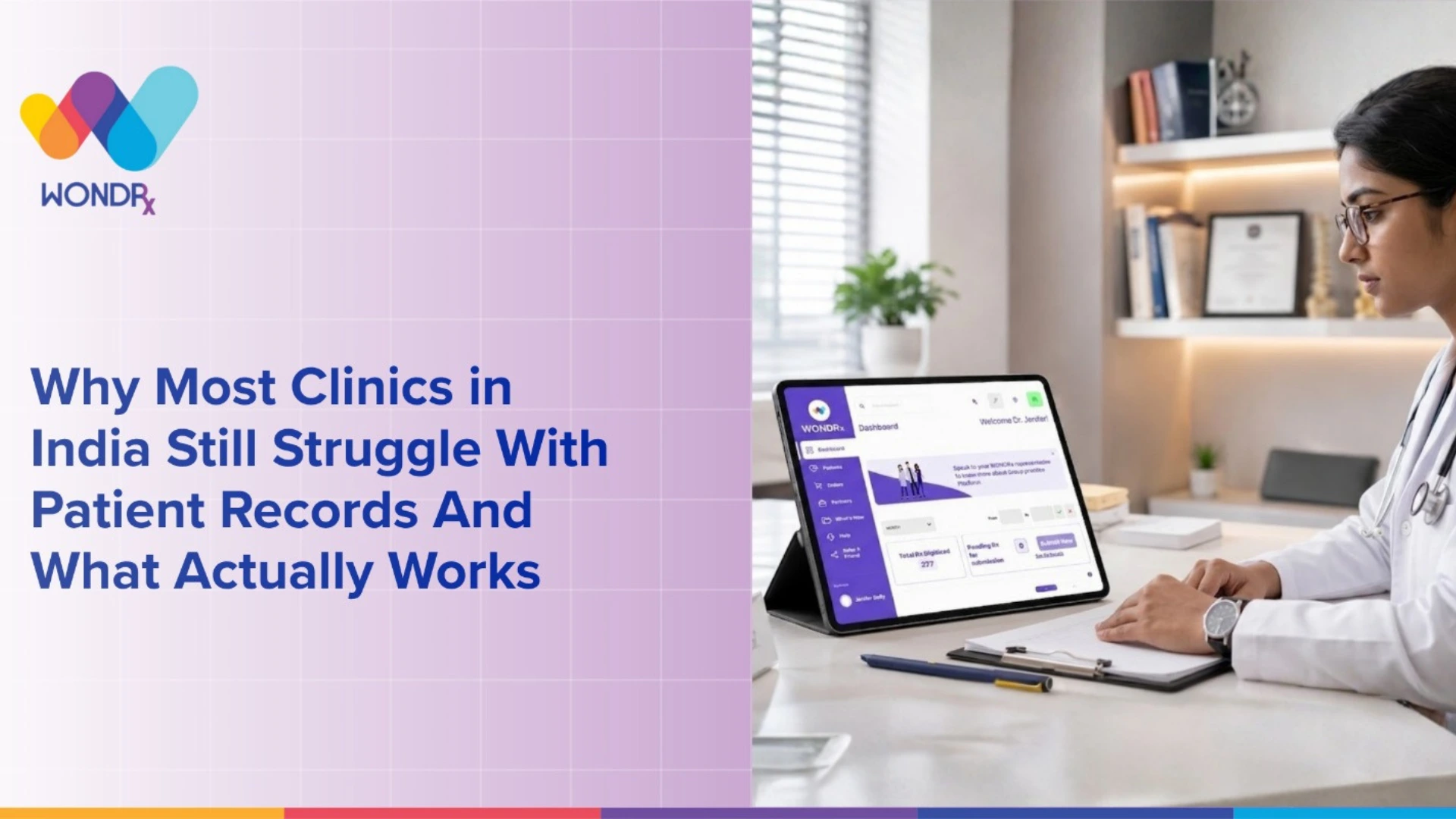
WONDRx is a smart prescription built around one idea: doctors shouldn’t have to change how they write prescriptions to get digital records. The goal is to let doctors continue writing prescriptions in their familiar workflow, while WONDRx captures and converts the prescription into digital information. WONDRx is designed to capture a handwritten prescription and convert it into a structured digital record.
No prescription typing during the consultation. No need to switch to a new interface mid-consultation. And no need to disrupt the existing handwriting workflow. That is designed to minimize behavior change by keeping the doctor’s familiar handwriting workflow at the center of the process.
How WONDRx Fits Into EHR vs EMR Conversation
Here’s the practical part: WONDRx doesn’t ask you to pick a side in the EHR vs EMR decision. It gives you digitized, structured prescription data that can be integrated with compatible EMR/EHR systems, depending on the available integrations and technical requirements, whether that’s a simple EMR for your own records or an EHR setup aligned with ABDM.
The doctor can continue writing prescriptions by hand without having to switch to keyboard-based prescription entry. WONDRx is designed to convert handwritten prescriptions into structured digital information that can be used with compatible EMR/EHR workflows, subject to the capabilities and integration requirements of the systems involved, a digital version that can be easier for pharmacists and patients to read, and a searchable prescription history, without requiring doctors to enter prescription details through additional on-screen fields during the consultation.
This is clinic digitization India actually needs at OPD level: not a system that demands new habits, but one that captures habits you already have and makes it digital.
Real OPD Impact: What Changes When Digitization Doesn’t Require Typing
Picture the same Tuesday OPD, 40 patients, one doctor, four minutes each. With WONDRx, doctors can continue writing prescriptions in their familiar handwriting workflow. What changes is what happens after the prescription is written.
prescription is now legible for pharmacists down corridor, instead of being deciphered patient by patient. It’s searchable if the same patient walks in three months later with a different complaint. It can provide structured prescription data for integration with compatible EMR/EHR systems, subject to the specific integration and ABDM requirements.
That can make the difference between a digitization workflow that fits a real OPD and one that becomes difficult to sustain in daily practice.
Conclusion: It Was Never Really EHR vs EMR
EHR and EMR is worth knowing. An EMR generally focuses on clinical records within a particular practice or organisation, while an EHR is designed to provide a broader view of health information and support interoperability across authorised providers and healthcare settings, and increasingly, the direction India is heading with ABDM. If you’re choosing between two for a multi location hospital versus a solo OPD, that distinction genuinely matters.
But for most Indian doctors, the question that decides whether digitization actually works isn’t EHR versus EMR. It’s whether the system respects four minutes you have per patient, or asks you to find time you don’t have.
WONDRx was built around the answer we believe in: software should adapt to doctors, not the other way around. If you want to see what that looks like in a real OPD instead of a slide deck, book a demo with WONDRx and see how a handwritten prescription becomes a digital one without changing a thing about how you practice.
FAQs
What is the main difference between EHR and EMR?
An EMR generally focuses on clinical records maintained within a particular practice or organization. An EHR is designed to support a broader, longitudinal view of health information and interoperability across authorized providers and systems.
Which is better for a small OPD or solo clinic, EHR or EMR?
For a single doctor OPD focused mainly on its own patient records, a simpler EMR is often enough. If your clinic expects to exchange information with other providers or participate in interoperable digital-health workflows, look for a system that supports the relevant standards and integration requirements. A better fit depends on how much your practice needs to share data outside its own four walls.
Is EMR software still relevant in India, or is everything moving to EHR?
EMR is still widely used across Indian clinics, especially smaller OPDs. But with ABDM pushing interoperability, more practices are moving toward EHR ready systems over time. EHR vs EMR shift in India is happening gradually, not overnight.
Does WONDRx replace my EMR or EHR system?
No, WONDRx isn’t a replacement for your EMR or EHR. It is designed to convert handwritten prescriptions into structured digital information that can feed into compatible EMR/EHR workflows. It solves part of what most EMR and EHR tools struggle with: getting accurate digital records out of a doctor’s handwriting without requiring typing.
Why do doctors avoid typing into EHR or EMR systems during OPD hours?
Typing takes time most OPD doctors don’t have. With high patient loads and only a few minutes per consult, stopping to type into fields breaks flow of consultation. This can be one of the barriers to adoption of digital prescription tools in busy Indian clinics.
How does WONDRx convert handwritten prescriptions to digital records?
WONDRx is designed to capture handwritten prescriptions and convert the information into a structured digital format, reducing the need for manual prescription entry. There’s no separate typing step, so the doctor’s workflow stays exactly the same while the clinic still gets EHR ready digital records.