TL;DR
- This blog is for Indian doctors and clinic owners evaluating EMR software. This blog helps you separate tools that work in real OPDs from ones that only work in sales demos.
- Most EMR software in India is built for admin teams, not for doctors seeing 80 patients a day who have no time to type.
- Right questions to ask a vendor focus on prescription workflow, OPD adoption, and behavior change, not just features and pricing.
- A doctor’s prescription habit is the most important workflow to evaluate if EMR disrupts it, adoption fails.
- WONDRx converts handwritten prescriptions to digital records without requiring doctors to change how they write, making it one of the only EMR solutions that works without requiring behavior change.
You have 60 to 80 patients today. You are writing prescriptions the same way you have for 15 years. Then someone tells you to switch to an EMR.
The vendor demo looked clean. The sales pitch was confident. The features list was long.
But here is what nobody told you: most EMR software in India was not built for how you actually work. It was built for how administrators wish you worked.
Most EMR software in India looks great in a demo but fails the moment it enters a real OPD.
The result? Expensive software that gets used for billing and appointment scheduling, while doctors quietly continue writing prescriptions by hand.
If you are evaluating EMR software in India right now, pause before you commit.
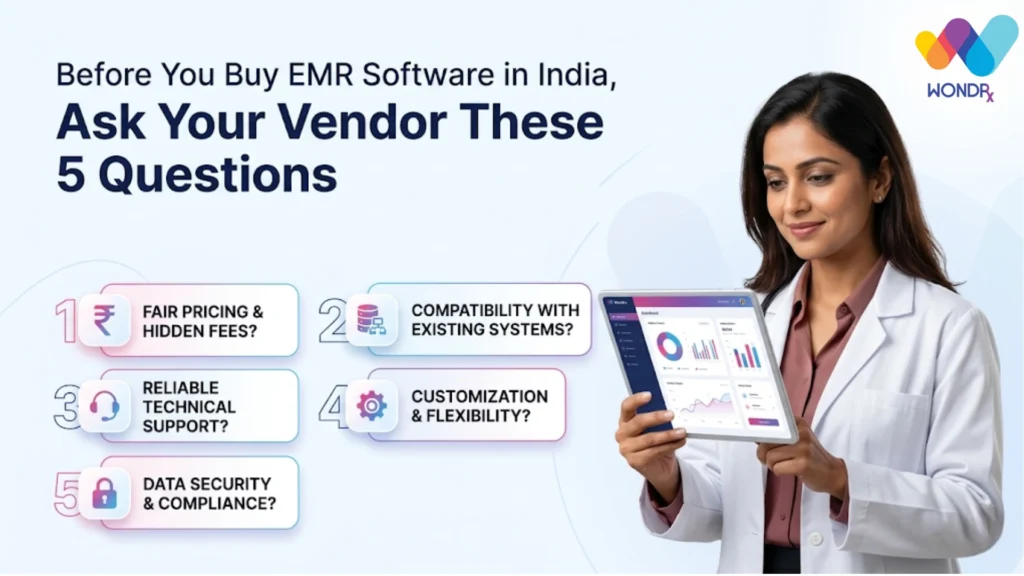
Ask your vendor these five questions. They will quickly reveal whether the system will actually fit into your daily practice or quietly get abandoned within three months.
Real Problem with Most EMR Demos
EMR vendors are very good at demos. They show you clean digital prescription forms, neat patient histories, and dashboards full of insights.
What they do not show you is what happens at 11 AM in your OPD, when 30 patients are waiting and you have 90 seconds per patient.
Most EMR software in India was designed by people who have never sat in a high volume OPD. They are designed for completeness, not for speed. For accuracy, not for flow.
The questions below are not about features. They are about workflow. They will tell you whether software will survive contact with your real clinic or quietly get abandoned after 60 days.
Question 1: Does Your Doctor Need to Type Anything to Write a Prescription?
This is the single most important question you can ask.
In India, most doctors write 60 to 100 prescriptions a day. They write them fast, in their own shorthand, with years of muscle memory behind every stroke. That is not a problem to fix. That is how medicine gets done at scale.
Most EMR software in India asks doctors to type. Some offer voice input. Some have template-based dropdowns. All of them require doctors to change what they do during consultation.
And that is exactly why adoption fails.
If a vendor cannot answer this question with a clear “no, doctor does not need to type,” then software is going to compete with the doctor’s existing habit. That is a battle software will lose every time.
What WONDRx does differently: WONDRx uses a smart prescription device that converts handwritten prescriptions into digital records automatically. The doctor writes on paper, exactly as always. A digital record is created without any extra step, any typing, or any change in behavior.
Very few EMR solutions in India currently offer this approach.
Question 2: How Long Does It Take a New Doctor to Write Their First Digital Prescription?
This question separates real ease of use from marketing language.
Every vendor will say their software is “intuitive” and “easy to use.” Ask them to be specific. On day one, with no training, can a doctor sit down and write a prescription in under two minutes?
If the answer involves a training session, an onboarding period, or a learning curve of any kind, that is your answer.
In a 60 patient OPD, there is no room for learning curves. There is no time to remember which dropdown to open or which template to select. If software slows the doctor down even slightly in the first week, it will be pushed aside permanently.
The best EMR software in India for high volume OPDs is one where a doctor does not have to learn anything new at all.
Question 3: What Percentage of Your Clients Actually Use Prescription Modules Daily?
Most vendors will not have a clean answer to this question. That itself is revealing.
The prescription module is the heart of any EMR software for doctors. If it is not being used daily, software is being used as an expensive appointment scheduler and nothing more.
Ask for real numbers. Ask to speak to a clinic of similar size and patient volume. Ask what percentage of doctors in multi doctor clinics are actively using software six months after onboarding.
Low adoption rates are a dirty secret of the EMR industry in India. Vendors sell licenses, not outcomes. Software gets installed, IT is satisfied, but doctors keep doing what they were doing before.
Before you buy, make sure you are buying a tool that will actually be used.
Question 4: What Happens to Existing Paper Records?
This question catches most vendors off guard.
Your clinic has years of patient history in paper files. Stacked in registers, filed in folders, stored in cabinets that have become part of the clinic’s memory. When you switch to an EMR, what happens to all of that?
Most EMR software in India offers no real answer here. They expect you to either digitize everything manually, an enormous task or accept that your digital records will only begin from the day of implementation.
That creates a dangerous gap. A patient comes in after three years. Their history is on paper. EMR shows a blank profile. The doctor has to stop and dig through files, defeating the entire point of software.
Ask your vendor how they handle historical records. Ask whether software allows a parallel workflow during transition. Ask how handwritten prescription data from existing OPD registers will be captured.
If there is no clear plan for this, transition will create more chaos than it solves.
Question 5: What Does Your Off boarding Process Look Like?
This is a question no one thinks to ask until they need to leave.
Healthcare data is sensitive and long lived. Patient records from today may be needed five or ten years from now. Before you commit to any EMR software in India, you need to know: if you ever want to switch vendors, can you get all your data out?
Ask for this in writing. Ask about file formats. Ask about how long a vendor retains your data and what access you have during and after the contract period.
This question also tells you something about how a vendor thinks about its relationship with you. Vendors who make boarding easy are confident in their product. Vendors who are vague or evasive about this are banking on the difficulty of switching to keep you locked in.
One Question That Changes Everything
There is a sixth question underneath all of these, and it is most honest one you can ask yourself:
Will my doctors actually use this?
Most clinic digitization efforts in India fail not because of bad technology but because of mismatched expectations. Software asks doctors to change. Doctors, who are already doing most cognitively demanding work in the clinic, push back. Not because they are resistant to technology but because technology is asking for something it has not earned.
Software should adapt to doctors. Not the other way around.
This is the exact problem WONDRx was built to solve. By converting handwritten prescriptions to digital records with no typing, no templates, and no workflow disruption, WONDRx is designed to work with how doctors already practice.
High volume OPDs. Busy consulting rooms. Doctors write 80 prescriptions a day. WONDRx fits into all of it without asking anyone to change.
Why WONDRx Passes All Five Questions?
Most EMR vendors in India struggle to answer even two of the five questions above clearly. WONDRx was built specifically to pass all of them.
Here is what that actually looks like in a real OPD.
No typing. Ever. WONDRx uses a smart prescription device placed on your existing writing desk. You write your prescription on paper, exactly the way you always have. WONDRx reads it and converts it into a structured digital record automatically. No keyboard. No mic. No template. Your handwriting is the input.
Zero onboarding time. Because the doctor does not change anything about how they write, there is nothing to learn. A doctor seeing their first patient on day one of WONDRx is working exactly the same way as a doctor on day 100. The only difference is every prescription is now digitally captured.
Prescription module used at 100% – by design. Most EMRs report low daily prescription module usage because the module requires effort the doctor did not sign up for. With WONDRx, the prescription module is the prescription pad. Every handwritten prescription is captured automatically. There is no separate step to “use the module.”
Parallel workflow during transition. WONDRx does not require you to abandon paper. You keep writing on paper. The device captures what you write. Your historical paper records stay as they are. New records build digitally from day one, with no pressure to digitize old files before you can start.
Your data is always yours. WONDRx stores your prescription data in structured, exportable formats. If you ever need to move, your records go with you. No lock-in, no hostage situations, no dependency on a vendor relationship to access your own patient history.
This is what clinic digitization looks like when the software is designed around the doctor’s workflow, not the other way around.
Conclusion:
The best EMR software in India is not one with most features. It is one your doctors will actually use every single day, without being reminded.
Before you sign any contract, run your shortlisted vendors through these five questions. answers will tell you more than any product sheet or sales presentation ever will.
If a vendor cannot tell you that your doctors will not need to type, cannot show you real adoption data, and cannot explain how they will handle your existing paper records, you already have your answer.
Ready to see what a zero behavior change prescription workflow actually looks like?
Book a WONDRx demo and watch how a handwritten prescription becomes a digital record in real time with no typing, no training, no disruption.
FAQs
Q: What is the most important factor when choosing EMR software in India?
Workflow fit matters more than features. Best EMR software in India is one your doctors will use without any disruption to how they currently work especially for writing prescriptions. If adoption requires behavior change, it will fail in high volume OPD settings.
Q: Why do most doctors in India not use prescription modules in EMR software?
Because most EMR software requires doctors to type or use templates, which slows them down during consultations. In a 60-80 patient OPD, any extra step is a step that gets skipped. Sustainable adoption requires zero additional effort from doctors.
Q: How is WONDRx different from other EMR software in India?
WONDRx converts handwritten prescriptions into digital records without requiring doctors to type, click templates, or change anything about how they write. The doctor writes on paper as always, and a digital record is created automatically making it the only EMR solution built around zero behavior change.
Q: Is EMR software in India compliant with ABDM and government health regulations?
Most modern EMR systems are built with ABDM compatibility in mind. However, compliance alone is not a reason to choose a platform. Evaluate compliance alongside workflow fit, adoption rates, and prescription module usability before making a decision.
Q: What should I ask about data ownership before buying EMR software?
Ask the vendor for a clear off boarding process in writing. You should know what formats your data can be exported in, how long the vendor retains your records after contract end, and whether you have uninterrupted access to your patient data at any point during or after contract.