
TL;DR
- This blog is written for OPD doctors and clinic owners in India who are tired of losing patient records, managing paper chaos, and handling complaints from returning patients who have to repeat their entire history.
- Lost prescriptions are not a storage problem, they are a workflow problem. Paper-first clinics will keep losing records until the capture step itself becomes digital.
- Most electronic medical records software fails in real OPDs because it demands typing, which no high-volume doctor has time for during a consultation.
- The fix is not asking doctors to change how they write, it is making what they already write automatically become a digital record.
- WONDRx converts handwritten prescriptions into structured digital records in real time, with zero typing and zero behavior change required from the doctor.
There is a specific kind of frustration that every clinic owner knows.
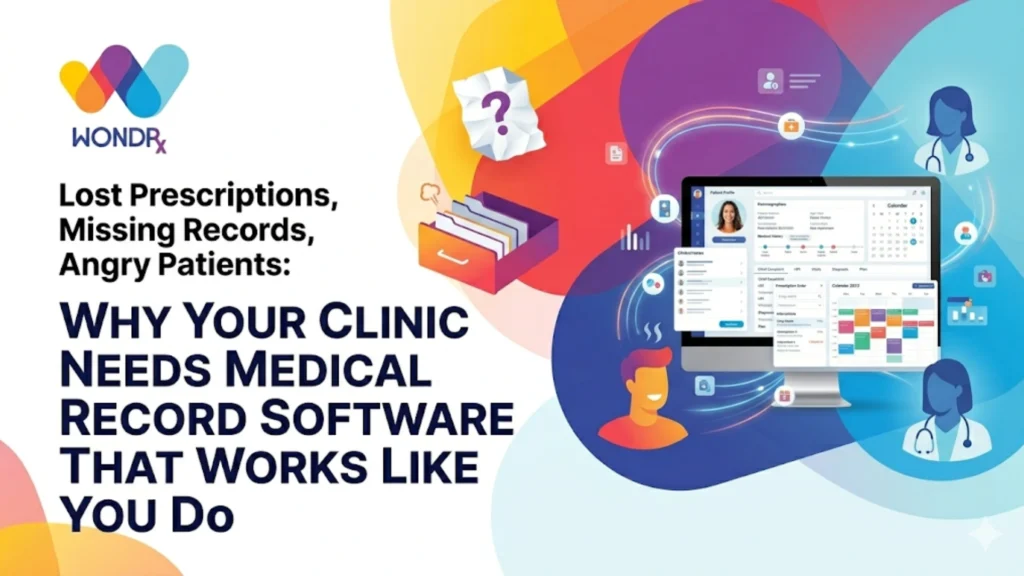
A patient walks in for a follow-up. They do not have their prescription from last time. They cannot remember the exact medicines they were given. They are not sure of the dosage. And now the doctor has to either guess from memory, ask probing questions for five minutes, or start fresh, because the physical copy that should have been filed is somewhere in a pile of papers, or worse, gone entirely.
This is not a rare situation. In most paper-based clinics, it is Tuesday morning.
Most clinics lose patient records not because doctors are careless, but because handwritten paper systems were never designed to scale. As patient volumes increase, prescriptions, follow-up notes, and diagnostic records become harder to organise, retrieve, and track consistently. Over time, even well-managed clinics begin struggling with missing files, delayed retrieval, and incomplete patient histories.
Medical record software exists precisely to solve this. But most electronic medical records software available today creates a different kind of frustration: it requires doctors to type. In a busy OPD where a doctor is seeing 60 to 80 patients a day, typing is not a minor inconvenience. It is a dealbreaker.
That is why many conventional EMR systems fail in real Indian OPDs. They are built around changing how doctors work instead of adapting to existing clinical workflows.
This blog explains what actually causes records to go missing, why traditional electronic medical records software often fails in high-volume clinics, and how a handwriting-first approach solves these problems without forcing doctors to abandon the way they already practice.
Also Read,
- Best Prescription Software for Busy Clinics
- From Handwritten to Digital: What the Prescription Transition Really Looks Like in an Indian Clinic
- 5 Simple Habits to Improve Your Daily Wellness Naturally
Why Do Clinics Keep Losing Patient Records?
The honest answer is not negligence. Most clinic staff are doing their best with a system that was not designed to handle volume they are managing.
In a typical setup, a doctor writes a prescription by hand. patient keeps original. A photocopy might be filed if the clinic has time and systems in place. But on a busy day with 70 patients, photocopying everything before it walks out the door is simply not realistic.
When a patient returns, the record depends on what they brought back. If they lost paper, the clinic lost records. There is no other copy.
The problem starts at the capture step. If the only digital record that exists is what someone manually entered into a computer later, or what was photocopied and physically filed, you already have a fragile system. One lost prescription, one missed filing, one staff member who was absent that day, and the record is gone.
Medical record software is supposed to solve this. The question is whether it actually does, or just shifts the problem.
Why Most Electronic Medical Records Software Fails in Real OPDs
If you have ever tried implementing an EMR or electronic medical records software in a high-volume clinic, you probably know how this goes.
The software demo looks clean. The features list is impressive. The sales team explains how it will organize everything, generate reports, maintain patient history, and make the whole clinic run smoother.
Then it goes live. And the doctor hates it.
Not because software is bad, but because using it requires something no OPD schedule has time for: typing during consultation. Every system that requires a doctor to enter data manually is competing with a patient sitting across the table, the next patient already waiting, and a consultation window that averages three to five minutes.
Most electronic medical records software was designed for hospital settings or for markets where consultation times are longer. It assumes a workflow where data entry is part of the visit. In Indian OPDs, data entry is something that has to happen without slowing down visits at all.
So what happens? software gets used for billing. Or it gets used for appointment scheduling. Or it gets abandoned after three weeks because staff found it easier to go back to paper. patient records that were supposed to be captured digitally never were.
records do not go missing because doctors resist technology. They go missing because technology asks too much.
Real Cost of Missing Patient Records
Missing records are not just an inconvenience. They have real, compounding consequences for clinics.
Returning patients repeat their full history. This takes time, frustrates patients, and creates the impression that the clinic does not care enough to remember them. In a city where patients have multiple clinic options, this matters.
Doctors make decisions with incomplete information. When a patient’s medication history from last visit is unavailable, the doctor is working with a gap. That gap might be harmless most of the time. But “most of the time” is not a reassuring standard for clinical care.
Medico-legal exposure increases. Under India’s DPDP Act 2023 and existing medical practice guidelines, clinics are expected to maintain proper patient records. If a complaint is raised, “we couldn’t find paper” is not a defensible position.
Staff time goes into searching, not serving. When a patient insists their prescription was filed, someone on your team is now going through a drawer or a folder trying to find it. That time adds up.
None of these are dramatic events. They are small daily costs that quietly erode the clinic’s reputation, its efficiency, and its ability to deliver consistent care.
What a Handwriting-First Approach Actually Looks Like
Here is an idea at the center of WONDRx: the problem is not that doctors write prescriptions by hand. The problem is that handwritten prescriptions do not automatically become digital records.
Fix that one thing, and the rest of the problem unravels.
WONDRx is a medical record software built around handwriting, not around typing. A doctor writes a prescription exactly as they always have, on paper or on a smart prescription pad, and WONDRx converts that handwriting into a structured, searchable digital record in real time.
No typing. No new workflow. No learning curve.
The doctor’s behavior does not need to change at all. What changes is what happens to what they write. Instead of a physical copy that walks out the door with a patient and may never return, there is now a permanent digital record attached to that patient’s profile.
When a patient comes back, their history is there. medicines from my last visit are there. A doctor can see the full picture in seconds, not from memory, but from an actual record.
This is what electronic medical records software should have been doing from the beginning: capturing data at the moment it is created, without adding a single extra step for the doctor.
How WONDRx Works in a Real OPD
Workflow is straightforward enough to explain in three steps.
The doctor sees the patient and writes a prescription, exactly as they would in any other consultation. No special technique, no new format.
WONDRx reads handwriting and converts it into a digital record: patient name, date, medicines prescribed, dosage, instructions, and diagnosis are all extracted and stored automatically.
The record is now searchable, retrievable, and linked to the patient’s profile. Next time that patient walks in, anyone in the clinic can pull up their full history in seconds.
For doctors, it feels like nothing has changed. For the clinic, everything changed.
Staff are no longer searching for paper files. Returning patients do not have to re-explain their history. The doctor has context before consultation begins. And clinic now has a growing, organized database of patient records that did not exist before
What Clinics in High-Volume OPDs Report After Switching
The impact of moving to a handwriting-first medical record software is most visible in small daily moments that used to cause friction.
A receptionist who used to spend 20 minutes before a busy session pulling patient files now pulls up records on a screen in 10 seconds. A doctor who used to start a follow-up consultation by asking “what did I prescribe you last time?” now already knows. A patient who expected to repeat themselves is surprised that the clinic remembers them.
None of this requires a doctor to do anything differently. Handwriting to digital conversion happens in the background. The doctor is not aware of it as a process. They just write, and records exist.
For clinics running 50 to 100 patients a day, this is not a marginal upgrade. It is the difference between a clinic that has records and one that does not.
Is Your Clinic Still Running on Paper Memory?
If your clinic’s patient records live primarily in physical files, in patient-held prescriptions, or in a system that requires staff to manually enter data after the fact, you have a records gap. It will keep growing longer clinic runs.
The solution is not to ask your doctors to type faster or file better. It is to make the act of writing a prescription, which they are already doing, automatically create a digital record.
That is what WONDRx does. And it works at the scale of real Indian OPDs, including clinics seeing 80 or more patients a day.
If you want to see how it works in a clinic setup similar to yours, book a demo. No commitment, no jargon, just a real look at how your clinic’s records could run.


Great article! The right medical record software can help busy clinics organize patient information, reduce paperwork, and improve daily workflows. Choosing a system that fits the clinic’s needs is key to better efficiency.
–
Ciyex – open source EHR
https://ciyex.org/