TL;DR
- This blog is for OPD doctors and clinic owners in India who are considering medical record software but have either tried it before, found it disruptive, or are skeptical about it fitting into their actual workflow.
- The real reason pen and paper still dominates Indian OPDs is not technophobia; it is that most medical record software demands a behavior change doctors simply cannot afford during a busy OPD consultation.
- The fix is not better typing software.. It is a system that converts handwritten prescriptions to digital records without changing how a doctor works.
- WONDRx is built specifically for this: no keyboard, no templates, no screen staring, just write as you always have and records get digitized automatically.
- Doctors who have tried WONDRx report keeping their natural flow intact while finally having searchable, structured patient history at their fingertips.
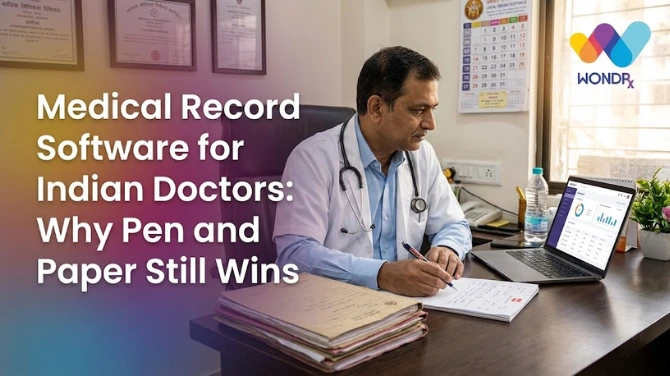
Walk into almost any busy OPD clinic in India—a general physician in Jaipur, a pediatrician in Pune, or a specialist with a packed waiting room—and you will find the same thing on the desk: a prescription pad and a pen. A prescription pad. A pen.
Not because the doctor hasn’t heard of medical record software. Not because they are opposed to technology.
It is because every digital system they have tried has asked them to do one thing they cannot afford to do: stop looking at patients.
This blog is about that gap. And about why the answer is not yet another EMR with a better interface.
Also Read,
- Why Most Clinics in India Still Struggle With Patient Records
- How to Digitize Your Clinic: Why E-Prescription Software Is Just the Starting Point
- Best Prescription Software for Busy Clinics in India
Real Reason Paper Still Wins in Indian OPDs
India has no shortage of medical record software. There are apps, cloud platforms, tablet based EMRs, and AI prescription tools list is long. And yet, Despite the availability of digital record systems, many private OPD clinics continue to rely on paper-based workflows., while pen and paper continues to dominate in many private OPD clinics where most Indians actually seek care.
This is not a technology awareness problem. Most OPD doctors know what EMR software is.
The problem is workflow reality
A typical OPD consultation in India runs between 3 and 7 minutes. In that window, a doctor is reading body language, asking follow up questions, recalling what this patient came in with six months ago, making a diagnosis, and writing a prescription. The moment they shift their gaze to a keyboard or a tablet screen to log data, something breaks. The patient feels it. The doctor feels it.
Many doctors feel that frequent screen interaction can interrupt the natural flow of a consultation.
That trust is not a soft metric. In a private OPD clinic, it is business.
So doctors made a rational choice: keep a pen, keep eye contact, keep flow. Worry about records later or not at all.
What Most Medical Record Software Gets Wrong?
standard pitch for EMR or EHR software in India goes something like this: digitize your patient records, reduce errors, access history from anywhere, generate e prescriptions with a click.
All of that sounds reasonable. The problem is a hidden assumption buried inside every one of those features.
Most EMR systems require significant on-screen interaction, whether through typing, clicking, templates, or structured data entry.
And typing in an OPD is not a minor adjustment. It is a fundamental shift in how a consultation works. A doctor who has spent 15 years writing a prescription in 90 seconds now needs to navigate a dropdown, select a drug, adjust a dosage, confirm a frequency. If the template does not match their specialty style, they start from scratch. If software lags or the internet drops, the queue grows.
Even most thoughtfully designed EMR software carries this structural flaw: it adapts doctors to software, not the other way around.
This is why adoption rates stay low. It is not resistance to change. It is doctors protecting one thing that cannot be compromised in a high volume OPD consultation itself.
Behavior Change Problem Nobody Talks About
Here is an uncomfortable truth that most EMR vendors do not address directly.
Getting a doctor to switch from paper to software is not a training problem or a pricing problem. It is a behavior change problem. And changing habits during a patient consultation in the middle of a consultation, under time pressure, with a patient watching is uniquely hard.
Doctors who successfully adopt digital systems tend to work in lower volume setups, have dedicated staff to handle data entry, or have built rigid templates that cover 80% of their cases. These conditions describe a small fraction of Indian OPD practice.
For everyone else, math simply does not work. The productivity cost of learning a new system, adapting to its quirks, and maintaining it every single day is higher than whatever efficiency gain software promises on paper.
This is not a criticism of those doctors. It is a design failure in the software category.
What Zero Behavior Change Actually Means?
A question worth asking is: what would medical record software look like if it was designed around how Indian OPD doctors actually work, not how software companies wish they worked?
The answer would look like this:
The doctor keeps their prescription pad. They write exactly as they always have. Their handwriting, their shorthand, their format. No templates, no dropdowns, no mandatory fields.
Behind scenes, that handwritten prescription gets converted into a structured digital record of patient name, diagnosis, medicines, dosage, date automatically. The doctor does not do anything differently.
Next time that patient walks in, the doctor’s assistant pulls up a clean digital history. Not a pile of folders. Not a manual search through a register. A searchable record, built entirely from prescriptions the doctor wrote by hand.
That is zero behavior change. And that is the only model that actually works in a busy Indian OPD.
How WONDRx Makes Handwriting Work as Medical Record Software?
WONDRx is built on exactly this principle. It is not an EMR asking you to type. It is a clinic digitization system that starts from your prescription pad and works forward from there.
Here is how it works in practice:
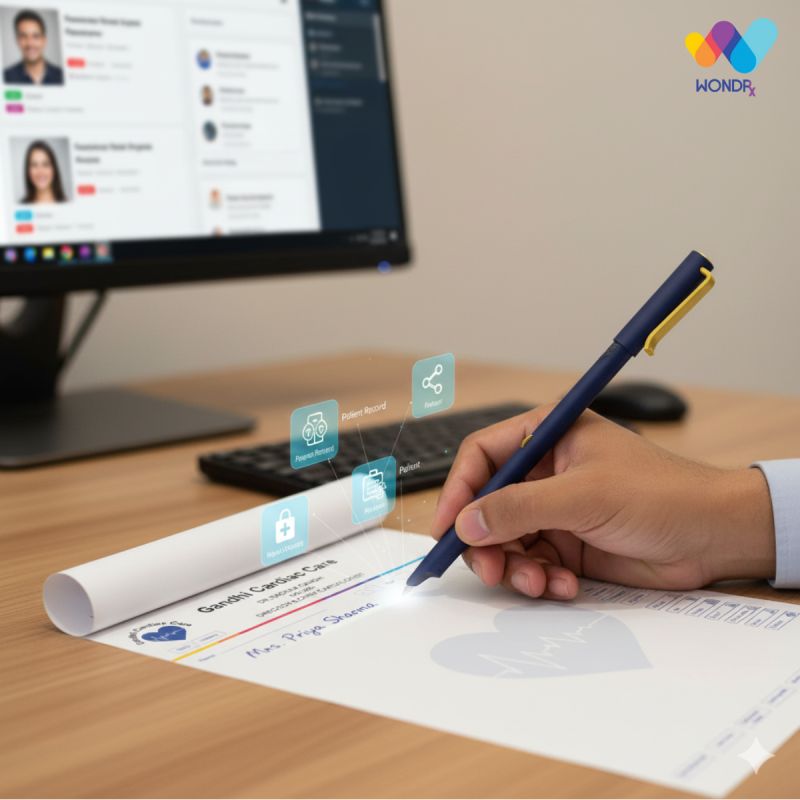
A doctor writes a prescription as usual on their pad, in their handwriting. WONDRx captures and converts that prescription into a digital record using handwriting recognition technology. The patient gets a clean, readable digital copy. The clinic gets a structured record that is automatically filed.
No keyboard. No login screens during consultation. No disruption to the 4 minute rhythm of a busy OPD.
Over time, doctors build a complete digital patient history without ever having changed how they write prescriptions. software adapted to doctors. Not the other way around.
For clinics already managing hundreds of patients a month, this means finally having searchable, retrievable medical records without adoption cost that has stopped every previous attempt at digitization.
Real OPD Impact: What Changes and What Does Not
For doctors considering WONDRx, the most important thing to understand is what does not change.
The prescription pad stays. The writing style stays. consultation flow stays. speed stays.
What changes:
- Patient history is now searchable. No more asking patients to recall their last visit or hunting through a stack of old prescriptions.
- Prescriptions are legible. Every patient receives a clean digital copy, reducing risk of pharmacy errors.
- Records can help clinics prepare for evolving digital health and data management requirements, including initiatives such as ABDM and the DPDP Act 2023.
- The clinic looks professional without the doctor having done anything differently.
For a doctor seeing 50 patients a day, none of these changes required a single day of retraining or a single adjustment to how they consult.
Why Does This Matters More Now Than It Did Five Years Ago?
The regulatory environment around patient records in India is tightening. Ayushman Bharat Digital Mission is pushing clinics toward digitized, linkable health records. Courts have flagged illegibility and inaccessibility of handwritten prescriptions as a patient safety issue. The DPDP Act 2023 introduces new requirements around the handling and protection of personal data, including healthcare information.
For most small and mid size OPD clinics, these developments are somewhere on the horizon not an immediate crisis. But they will arrive. And clinics that have been quietly building digital records in the background without disruption, without retooling, using a system like WONDRx will be in a completely different position than those still running on paper registers.
The time to start building that foundation is not when it becomes mandatory. It is now, while the transition can happen with minimal disruption to daily operations.
Conclusion: Pen Is Not Problem
Medical record software in India has a long history of being designed for systems, not for doctors. Features built around hospital workflows, pricing models that assume large teams, interfaces that demand doctors become a data entry operator.
None of that fits an OPD doctor with a packed waiting room and a four minute window per patient.
The pen wins not because it is better technology. It wins because it demands nothing from the doctor except what they already know how to do.
The right medical record software for Indian doctors does not fight that logic. It works with it. It takes what doctor already produces a handwritten prescription and turns it into something structured, searchable, and future ready.
That is what WONDRx does.
If you see 30, 50, or 80 patients a day and have been waiting for a digital system that fits your clinic without breaking it, this is worth a conversation.
Book a demo and see how WONDRx works in an OPD that looks like yours.
FAQs
Is medical record software useful for small single doctor clinics in India?
Many medical record software platforms are designed with larger clinics or multi-doctor practices in mind, which is why it often feels overcomplicated for a solo OPD practice. WONDRx is built differently; it works for single doctor clinics where the doctor is also the owner, with no extra staff needed to manage data entry.
Do doctors need to change their prescription format to use digital medical records?
With most EMR and EHR software, yes doctors are expected to use software’s templates and formats. WONDRx is an exception: it reads and digitizes a doctor’s existing handwritten prescriptions, so no format change is required.
What is the difference between EMR software and EHR software for Indian clinics?
EMR (Electronic Medical Record) software stores records within a single clinic’s system. EHR (Electronic Health Record) software is designed to share records across providers and systems. For most OPD clinics in India, an EMR is a practical starting point and a handwriting first system like WONDRx is the most friction free way to build one.
How does WONDRx handle patient data privacy under Indian regulations?
WONDRx is designed to support clinics in managing patient records securely while aligning with evolving digital health and data protection expectations. Patient data is stored securely and is not shared without authorization.
How long does it take for a clinic to start seeing benefits from medical record software?
With typing based EMR software, the learning curve can run from two weeks to a couple of months before a clinic returns to normal productivity. With WONDRx, there is no learning curve doctor writes as they always have, and digital records start building from day one.
Will WONDRx work in a high volume OPD with 60+ patients a day?
Yes. WONDRx is specifically designed for high volume OPD conditions where speed and simplicity are non-negotiable. The system does not slow down consultation; it runs entirely in the background of how the clinic already operates.