TL;DR
- This blog is targeted at Indian doctors, clinic owners, and healthcare practitioners looking to adopt digital prescription software for better efficiency and patient care.
- Handwritten prescriptions are still common but lead to issues like illegibility, medication errors, and poor record management.
- Digital prescription software helps streamline workflows with features like e-prescriptions, patient records, and drug databases.
- The transition is gradual, involving initial resistance, training, and a hybrid approach before full adoption.
- Despite challenges, digital prescription software improves accuracy, saves time, enhances patient trust, and prepares clinics for the future of digital healthcare.
This has been experienced by most doctors in India at least once.A pharmacist calls back and says,“Doctor, what is written here?”Prescriptions are hastily written in a busy clinic to save time. However, this speed can be rather costly in the form of illegible handwriting, omissions, and lack of documentation.Handwritten prescriptions have been effective over the years. But as clinics grow, this system starts to break down.Digital prescription solutions are not a disruption, but a smarter approach to what doctors already do.
Handwritten prescriptions create three real problems in daily practice:
• Clarity issues → pharmacists struggle to read prescriptions
• No patient history → difficult to track repeat visits
• Manual workload → time lost searching old records
Over time, this affects both efficiency and patient trust.
These problems may impact patients and healthcare providers. Pharmacists might require more time to interpret ambiguous prescriptions, and patients might not necessarily receive the right medicines in time. This demonstrates that a more efficient and effective system is required.
This is where digital prescription software is slowly coming in as a viable solution. These tools bring structure, accuracy, and accessibility, introduce order, precision, and accessibility to the prescribing process, and they assist clinics in transitioning to a more efficient and dependable system. As the healthcare ecosystem in India continues to go digital, the transition to digital prescriptions is no longer a mere upgrade, but a necessary measure towards safer, smarter, and more efficient patient care.
What is Digital Prescription Software?
Digital prescription software allows doctors to create and store prescriptions electronically instead of relying only on handwritten notes.It brings structure to prescriptions, reduces errors, and makes patient records easy to access during follow-ups.
It includes key features such as e-prescription generation, patient record management, and drug database integration. Within a clinical practice, physicians have the opportunity to input patient information, order medications, and create clear prescriptions in a matter of seconds, with everything being automatically stored to be easily accessed and provide further care.
Why Indian Clinics Are Moving Toward Digital Prescriptions
The Biggest Challenge: Doctors Don’t Want to Change How They Work Most doctors assume going digital means:
• Typing during consultations
• Learning new systems
• Spending more time per patient
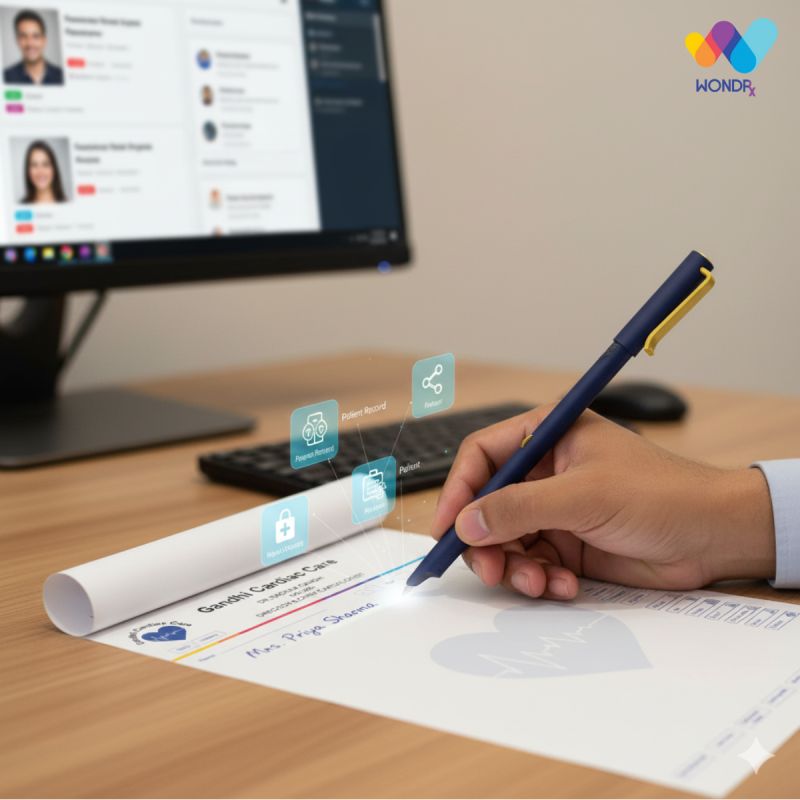
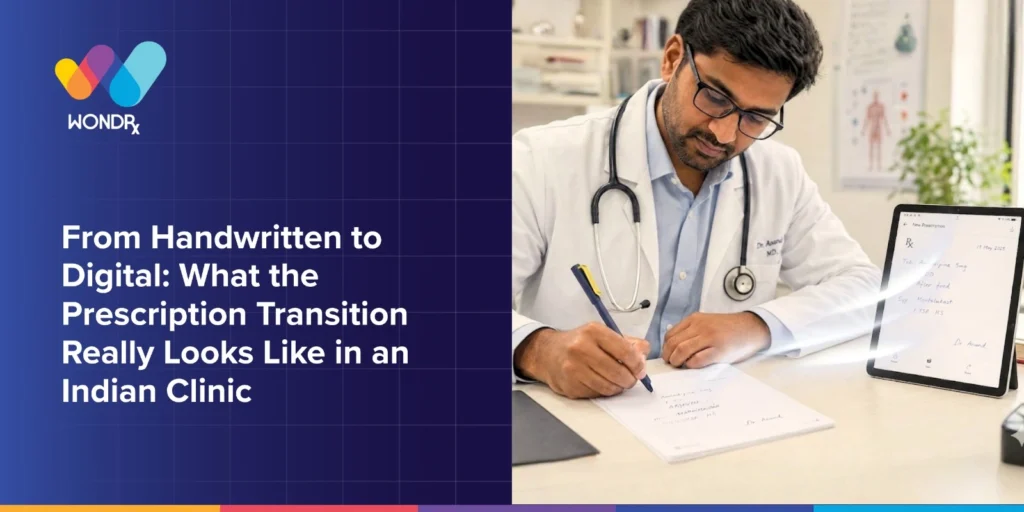
This is the point at which adoption decelerates.However, this is being solved differently by modern solutions.WONDRx Smart Rx enables physicians to keep writing on paper, and automatically generates a digital prescription in seconds. :contentReference[oaicite:0]{index=0}No typing. No disruption. No change in habit.
What the Prescription Transition Really Looks Like in an Indian Clinic
The transition of handwritten prescriptions to digital prescription software used in Indian clinics is a slow one that is undertaken due to the need to increase efficiency, accuracy, and patient management. Although paper based systems are still in common use, such persistent problems as illegible handwriting, medication mistakes, and insufficient records keeping promote the use of digital alternatives by clinics. This change typically starts with the growth of clinics, the implementation of teleconsultation, or the growing operational load.Nevertheless, the transition is not without challenges. The biggest challenge is initial resistance from doctors and staff, often due to the learning curve and setup process. A number of clinics start with a hybrid model and then switch. Digital prescription software increases the speed of workflow, minimizes errors, and fosters patient trust, which makes the clinics more organized, efficient, and prepared for the future of healthcare over time.
The Real Transition: Step-by-Step Process in an Indian Clinic
The transition to the digital prescription software in the Indian clinics will not occur at once. It includes changes in mindset, the selection of tools, their correct implementation, and gradual adjustment of the working process.
Initial Resistance and Mindset Shift
Initially, most physicians are reluctant to use digital prescription software. There is a general concern regarding the learning curve, extra time during the consultations and cost. The staff members can also have difficulties in adapting to new systems, particularly when they are accustomed to manual processes. Confidence starts to develop with time and the right training and exposure.
Choosing the Right Digital Prescription Software
Choosing appropriate digital prescription software is a very important process. The typical solutions sought by clinics include easy-to-use solutions, those that do not violate the healthcare regulations in India, and affordable solutions. Scalability is also a factor as clinics desire software that can expand with their practice and can handle increasing patient loads.
Implementation Phase
After the software is chosen, the clinics enter into the implementation phase. This involves installation of the system, training of doctors and staff. The data of patients can also be transferred into the system to maintain continuity of care. An implementation process that is smooth will mean that there will be minimal interference with the day to day operations.
Day-to-Day Workflow Changes
Once adopted, clinics start to observe the positive change in daily working processes. Templates and drug databases can be used to create the prescriptions faster. Connecting to billing systems and pharmacies facilitates operations, whereas unambiguous digital prescriptions enhance communication with patients. In the long run, e-prescription programs have become a routine clinical activity.
What Changes for Clinics After Going Digital
Clinics that adopt digital prescriptions typically see:• Faster consultations (less rewriting, no file searching)
• Fewer medication errors
• Better follow-up tracking
• Higher patient confidence
With solutions like WONDRx starting at around ₹20,000 per year, the transition is both practical and affordable. :contentReference[oaicite:1]{index=1}
Case Scenario:
A Typical Indian Clinic (Before Digital)
In a conventional Indian clinic, the majority of work is based on handwritten prescriptions, paper records, and manual tracking. This usually causes delays, mistakes and inability to handle patient information. Physicians might not be able to locate previous records and illegible handwriting can cause confusion to pharmacists and patients. On the whole, the procedure is less structured and time-consuming.
A Modern Indian Clinic (After Digital Adoption)
The workflow in a modern clinic with digital prescription software is much smoother and faster. The visit of a patient begins with the input of simple information into the system, and physicians can readily retrieve previous medical history. Prescriptions are created in seconds in a clear, readable format and can be printed or shared digitally. Follow-ups are also easier to follow up because all the records are kept in a single location, which enhances continuity of care and overall patient experience.
A typical Indian clinic that undergoes such a transition experiences a noticeable increase in efficiency and organization. A system that used to be full of delays and manual labor is now quicker, more precise, and easier to control, making the overall care of both doctors and patients more enjoyable.
Why Are Clinics Choosing Wondrx?
Why Are Clinics Choosing WONDRx?Because it removes the biggest barrier change.
• Doctors continue writing, no typing required
• Prescriptions become digital instantly
• Patient records are stored automatically
• Clinics stay connected with pharmacies and labs
WONDRx doesn’t replace the way doctors work.It improves it.
Tips for a Smooth Transition to Digital Prescription Software
- Start with a pilot phase to test digital prescription software on a small scale before full implementation.
- Select digital prescription software that is easy to use so that doctors and staff can easily adopt it.
- Train the staff to use the software efficiently.
- Make sure that there is good data backup and security to safeguard patient data.
- Gradually phase out handwritten prescriptions to allow a comfortable transition
Conclusion
The implementation of digital prescription software in the Indian clinics replacing handwritten prescriptions is a big step to modern, efficient, and patient centric healthcare. Although the traditional methods do not disappear, they are limited in accuracy, record keeping and efficiency of the workflow, which is why digital solutions are becoming more and more necessary. With the increased workload and difficulties in the functioning of the clinics, the need to implement digital prescription software turns into not a suggestion but a must.
Digitization of prescriptions is not a replacement of current practices.It’s about making them better. Clinics implementing the appropriate tools experience instant gains in clarity, efficiency, and patient experience without interfering with their workflow.The future of clinics is not to go completely digital overnight. It’s about taking the first step in the right way.
Thinking of Switching to Digital Prescriptions?
Start small. Try it in your clinic. Test it during real consultations. See the difference in clarity, speed, and patient experience.Because the right solution doesn’t change how you work.It simply makes it better.