TL;DR
- This blog is designed for pharma marketers, brand managers, and sales leaders in India who want to understand e-detailing, choose the right e-detailing software, and improve data-driven HCP engagement.
- Time is limited for doctors in terms of rep visits, every interaction must be relevant, and relevance is driven by knowledge of the doctor’s behaviour.
- In pharma, e-detailing supports the engagement layer by delivering approved content and capturing information about HCP interactions.
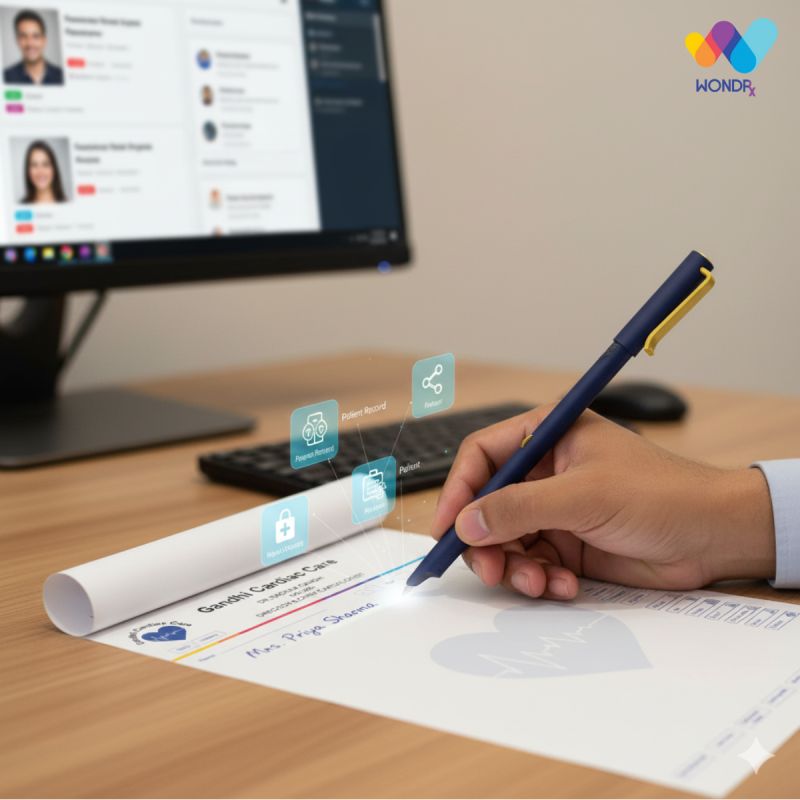
- WONDRx operates on another level. It formats handwritten prescriptions into digital prescription data from participating clinics, adhering to relevant privacy, consent and compliance rules.
- Prescription data can complement e-detailing by providing additional context for HCP segmentation and engagement. Both layers should be evaluated based on the team’s objectives.
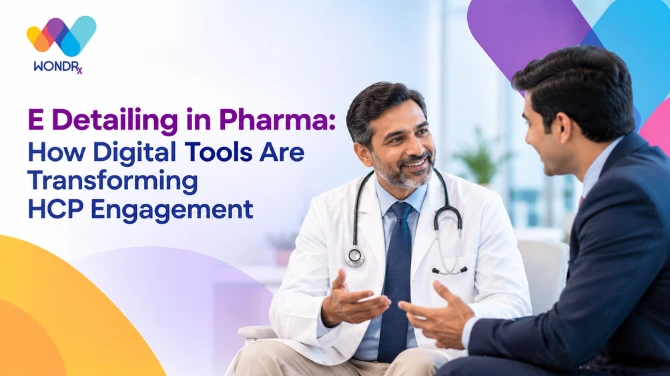
E detailing in pharma refers to the use of digital resources, including tablets, interactive presentations, video calls and web portals, for the delivery of product information to the healthcare professionals (HCPs). It substitutes the printed visual aid for an interactive, trackable and easily updatable content.
The change is significant because physicians have less time for pharma interactions, making every engagement more important. Rep visits are brief, doctors have a lot of work in the OPD, and content that is not relevant to a doctor’s practice is missed.
Solving part of the problem is by delivering content digitally. The second is understanding which doctors to engage, what to say, and why the message is relevant to them. It depends on the quality of the data that is available for the engagement – for that, e detailing platforms and prescription data tools have different roles.
This blog explains what e-detailing is, its most common formats, where WONDRx fits into data-driven HCP engagement, what to expect from e-detailing software, and how to measure its results.
Also Read,
- HCP Marketing: Strategies for Effective Healthcare Professional
- Pharma Commercial Analytics: Why Better Data Start
- MR Reporting System: How It Works and Why Pharma Companies
What Is E Detailing in Pharma, and How Does It Work?
E-detailing is an organized method of providing product, disease, and clinical information to healthcare professionals through digital devices. A medical representative may use an interactive presentation that includes slides, videos, animations, clinical information, and relevant case examples.
Behind the interface is a centralized content library where the marketing team stores approved materials. The marketing team uploads approved content that can be delivered to representatives’ devices. The platform then records interactions such as slides viewed, time spent on content, and questions or actions captured during the session.
Unlike printed materials, digital detailing can capture interaction data. Teams can see which content was viewed, how long it was viewed, and which materials were skipped or revisited.
What Are the Different Types of E Detailing?
Most pharma teams use a mix of three formats.
Face to Face E Detailing
The rep carries a tablet and presents interactive content during a clinic visit. This is common in India because many doctors still prefer a short in person meeting. The rep controls the flow and can jump straight to the slide that answers the doctor’s question.
Remote E Detailing
The rep presents live over a video call or screen share. Doctors who cannot be reached during clinic hours may accept a scheduled call at a more convenient time, and a remote session can allow a longer conversation than a quick clinic visit.
Self Detailing
The doctor opens the content on their own through a link, app or portal, at a time that suits them. This works well for follow ups after a rep meeting and does not need rep time for every contact.
Why Are Pharma Companies Moving to E Detailing?
Traditional printed visual aids and paper-based detailing have limitations in today’s pharma environment. E-detailing provides pharmaceutical companies with several benefits, including:
More focused HCP interactions. Interactive presentations allow reps to move quickly to relevant information instead of relying on folders of printed materials.
Consistent messaging. Each repetition is identical to an approved narrative that minimizes variability and compliance risks.
Faster content updates. When new content is approved, the marketing team can update the centralized content library so that the latest version can be distributed across devices. Teams can update approved digital content centrally instead of repeatedly printing and distributing revised materials.
Measurable engagement. The slide-level information is useful for determining what a physician cares about to help plan future calls and campaigns.
These benefits operate primarily at the engagement level. They can make interactions more efficient, consistent, and measurable, but their value ultimately depends on how well teams use the information to plan future engagements.
Where Does WONDRx Fit Into Data Driven HCP Engagement?
E-detailing platforms help pharmaceutical companies deliver and evaluate digital content used during HCP interactions. However, effective HCP engagement also depends on how well pharma teams understand physician behavior and prescribing patterns, where such data can be lawfully and appropriately used.
WONDRx addresses this data layer by converting handwritten prescriptions into structured digital prescription data from participating clinics, subject to applicable privacy, consent, and compliance requirements. Doctors can continue writing prescriptions by hand without switching to keyboard-based documentation or changing their existing consultation workflow.
WONDRx isn’t a web-based detail management system (e-detailer).It is not an alternative to a CLM system, e-detailing platform, tablet-based content management tool, call-center solution, or sales-force automation system. Instead, WONDRx can provide structured prescription data that may support these downstream applications, where legally and appropriately permitted.
Where lawfully available and appropriate, that structured data can support:
- Physician segmentation: grouping doctors by how they prescribe, not only by specialty or location.
- Understanding prescribing patterns: gaining visibility into prescription patterns captured from participating private OPDs, subject to the scope and quality of the available data.
- Therapy area targeting: focusing field effort on clinics and doctors relevant to a therapy area.
- More relevant HCP engagement: matching the message in an e-detailing deck to the therapy areas and prescription patterns relevant to a doctor’s practice.
- Measurement and commercial analytics: adding prescription level context to engagement reporting.
In practice, an e detailing platform can show that a doctor opened a clinical slide. Prescription data adds context on the doctor’s practice, which helps a team decide what to show next.
E Detailing vs Prescription Intelligence: Why Pharma Teams Need Both
The two work on different layers and answer different questions.
| E detailing | WONDRx |
| Delivers approved content | Digitises handwritten prescriptions |
| Tracks content engagement | Creates structured prescription data |
| Supports rep interactions | Captures data at the point of prescription |
| Measures digital content activity | Helps provide visibility into prescribing patterns |
| Engagement layer | Prescription data layer |
With only an e-detailing platform, a pharma team can understand how doctors engage with content but may have limited visibility into prescribing patterns. With prescription data alone, the team may understand prescribing behavior but lacks the engagement layer needed to deliver and measure promotional content.
E-detailing helps pharma teams communicate approved product and clinical information to physicians. WONDRx, by contrast, helps digitize handwritten prescriptions into structured prescription data.
How Does E Detailing Software Support Reps and Marketers?
E detailing software is the platform that stores content, delivers it to devices and records every interaction. In India, it is often bundled with sales force automation (SFA) and MR reporting tools, which handle call reporting, tour plans and expenses.
Core modules usually include:
- Closed loop marketing (CLM), where call data feeds back into the content strategy
- A content library with version control and approval status
- Offline mode, since many clinics have weak connectivity
- Doctor profiling and call planning
- Remote calling or screen sharing
- Dashboards for managers
The strongest platforms treat the rep’s workflow as the starting point. If logging a call takes longer than the call itself, adoption fails, no matter how good the analytics look.
What Should You Look for When Choosing E Detailing Software?
Most vendor pages list the same features, so the buying decision comes down to a few practical questions.
Does it work offline? Reps in Tier 2 and Tier 3 towns cannot depend on stable internet. Content and call data must sync later without loss.
Is compliance built in? Look for approval workflows, locked content versions, audit trails and the ability to restrict claims to approved material.
How easy is it for a rep to use? Test it with real reps, on real devices, in a real clinic. A tool that needs training sessions before it becomes usable will be abandoned within a quarter.
What does reporting show? Basic call counts are not enough. You want slide level engagement, doctor level history and content performance by specialty and region.
Does it connect to your data sources? CRM, SFA, and other approved data sources should be able to integrate where appropriate, so teams can avoid fragmented workflows and data silos.
What is the cost per rep? Compare licence, content production and support costs together, not the headline price alone.
How Does E Detailing Fit Within Indian Pharma Marketing Rules?
Pharmaceutical promotion in India is subject to the UCPMP 2024 and other applicable laws, regulations and professional requirements. Before launching a digital promotional campaign, companies should have the relevant content and processes reviewed by their regulatory and legal teams.
Good practices for digital detailing include using credible and appropriately referenced information, ensuring materials are reviewed and approved, removing outdated content, and maintaining appropriate records of information shared and the dates of sharing. Prescription information must also be verified for compliance to relevant laws regarding privacy rights, consent provisions and data security standards.
What Challenges Do Pharma Teams Face with E Detailing?
Most failures come from execution, not technology.
Rep resistance. Reps who built relationships on personal visits may see the tablet as a barrier. Training that shows how the tool helps them during the call changes this faster than mandates.
Heavy content. A 60 slide deck copied from a printed brochure does not work in a short call. Build short modules of 3 to 5 slides organised by doctor questions.
Connectivity. Without offline support, the app becomes the reason a call fails.
Doctor fatigue. Doctors already receive many emails, messages and calls. Self detailing links need a clear reason to open them, such as a new guideline or case study.
Weak targeting data. Even excellent content underperforms when it reaches the wrong doctor. Better data on physician behaviour improves who gets which message.
Data without action. Dashboards are only useful if a manager reviews them and changes the next call plan.
How Do You Measure the Success of E Detailing?
Measure engagement and commercial context separately.
Engagement metrics include calls with digital content per rep per day, average time per slide, completion of key messages and the share of doctors who reopen self detailing links.
Commercial metrics include reach and frequency across target doctors and, where lawfully available and appropriate, changes in prescribing patterns. These should be read as context, not as proof that a single campaign caused a result.
Tie each metric to a decision. If a clinical slide is skipped in most calls, rewrite it or move it. If a specialty responds better to remote calls, shift more of that segment’s contacts to that channel.
What Is the Future of E Detailing in Pharma?
Omnichannel engagement is replacing single channel calls, with the rep visit, a follow up email, a webinar and a self detailing link working as one journey. AI features are helping with content recommendations and next best action suggestions. Both depend on good data. A recommendation engine is only as useful as the information about physician behaviour that feeds it.
Tools that fit how doctors and reps already work get used. Tools that demand a new routine get ignored. That principle applies equally to engagement platforms and to prescription data tools.
How Can Pharma Teams Make HCP Engagement More Informed?
E detailing in pharma has become a core part of HCP engagement, but delivering content well is only half the job. The key takeaways are:
- E detailing is a mix of face to face, remote and self detailing, not one channel.
- The right e detailing software works offline, supports compliance and is simple for a rep to use.
- Short, modular content performs better than long decks.
- Engagement tools manage the content layer. Prescription data supports the targeting layer.
- Pilot with one product and one team, and check compliance requirements before scaling.
E detailing helps pharma teams communicate with doctors. WONDRx helps create the prescription data that can make that engagement more informed.
See How WONDRx Can Strengthen Your HCP Data Layer
Want greater visibility into prescription patterns from participating private OPDs? WONDRx digitises handwritten prescriptions without requiring doctors to change the way they prescribe. Explore how WONDRx can help create structured prescription data that supports more informed HCP segmentation, engagement and commercial analytics.
FAQs
What is e detailing in pharma?
E detailing is the delivery of product and clinical information to doctors using digital tools such as tablets, interactive presentations, video calls and web portals. It lets pharma companies track which content the doctor is engaged with.
What is the difference between e detailing and traditional detailing?
Traditional detailing uses printed visual aids and a face to face visit. E detailing uses interactive digital content that can be updated centrally and tracked at slide level. Both can be combined in a single call.
What features should e detailing software have?
Look for CLM, offline access, version controlled content, compliance and approval workflows, doctor profiling, remote calling and manager dashboards. Ease of use for reps matters as much as the feature list.
Is WONDRx an e detailing software?
No. WONDRx converts handwritten prescriptions into structured digital prescription data from participating clinics, subject to applicable privacy, consent and compliance requirements. It supports the data layer behind HCP engagement and does not replace e detailing software.
Is e detailing allowed in India?
Pharma companies use e-detailing in India, but promotion is subject to UCPMP 2024 and other applicable laws, regulations and professional requirements. Verify the current requirements with your regulatory and legal teams.
How do you measure e detailing ROI?
Look at relevant engagement, reach, frequency and, where lawfully available and appropriate, changes in prescribing patterns. Treat these as context for decisions rather than proof that one campaign caused a result.