
TL;DR
- This blog is for doctors, clinic owners, and hospital administrators in India trying to understand what EMR actually means and whether it is worth adopting in a high volume OPD.
- One challenge with EMR adoption is that many systems rely heavily on typing, data entry, or screen-based documentation, which can disrupt the rhythm of a busy OPD.
- EMR (Electronic Medical Record) stores a patient’s clinical history digitally within one clinic or hospital, while EHR extends that data across multiple providers.
- A good EMR should fit into how doctors already work, not force them to learn a new way of writing prescriptions.
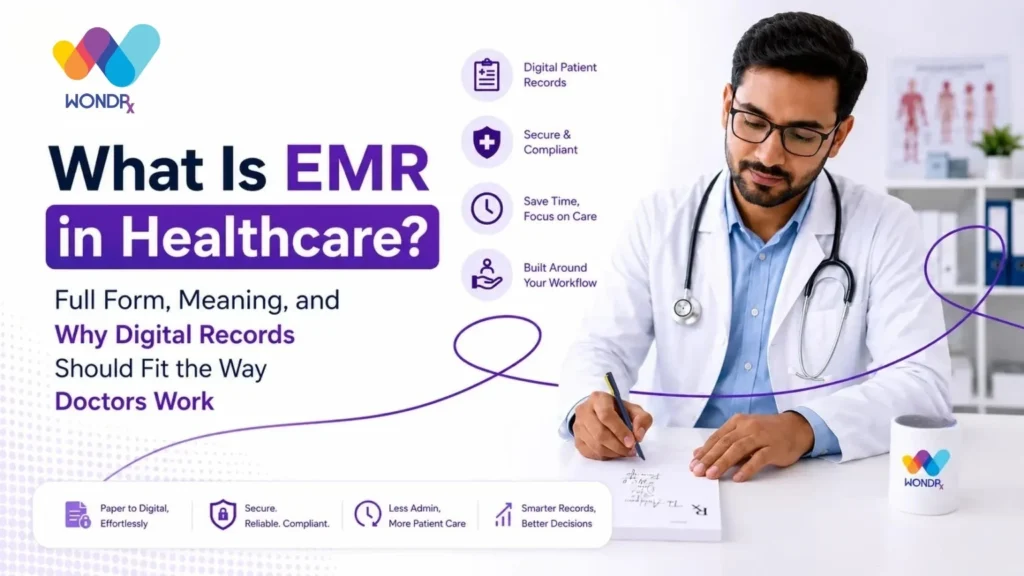
- WONDRx converts your handwritten prescription into a digital EMR record automatically, so you get the benefits of EMR without changing your handwriting or typing a single word.
Electronic Medical Records (EMRs) help doctors and clinics maintain patient information in a structured digital format. In a busy OPD, the challenge isn’t understanding what an EMR is. It’s getting patient information into a digital record without slowing the doctor down.
When prescription details, clinical notes, and patient information have to be entered manually during or after a consultation, documentation can add to a physician’s administrative workload. A well-designed EMR should therefore support the doctor’s existing workflow, making documentation easier without adding unnecessary steps.
So, what is EMR in healthcare, and why does it matter for doctors, clinics, and the wider healthcare system in India?
WONDRx is designed to simplify this process by converting handwritten prescriptions into digital EMR records, reducing the need to manually type prescription information into a digital system. This allows prescription data to be captured digitally while minimizing an additional documentation step for physicians.
This blog explains the full form and meaning of EMR in healthcare, the difference between EMR and EHR, the role of electronic medical records in modern healthcare, and why EMR solutions designed for busy OPDs may need to address different workflow requirements from hospital systems, where dedicated data-entry staff may be available.
Also read,
- Why OPD Data Is Missing in Pharma Commercial Analytics
- Medical Record Software for Indian OPD Clinics
- How Prescription Data Is Becoming the Most Valuable Asset in Pharma Sales
What Does EMR Stand For, and What Does It Actually Mean?
EMR full form is Electronic Medical Record. In simple terms, it is the digital version of the paper chart your clinic already keeps on every patient.
An EMR stores a patient’s medical history, diagnoses, medications, allergies, lab results, and prescriptions, all in one place, inside one clinic or hospital’s system. Think of it as the diary your clinic maintains on each patient, except it lives on a screen instead of a paper folder that can get misplaced, torn, or left at the wrong desk.
This is the core of what EMR in healthcare means: a single facility’s complete, searchable digital record of a patient’s care. An EMR is generally focused on records within a particular practice or healthcare organization, although some systems can exchange information with other providers through interoperability
Why Do EMR Systems Still Feel Like Extra Work in a Busy OPD?
This is what most EMR explainers fail to mention. In many high-volume Indian OPDs, doctors may have only a few minutes with each patient. It takes time to study, diagnose, and prescribe, and additional time to click through dropdown menus, look up drug names, and type notes on a computer screen.
Many EMR systems support clinical documentation, administration, billing, and other workflows. However, some can feel cumbersome when doctors see a high number of patients in a short OPD session. If the system adds too much typing or navigation, it can slow down the consultation despite having a modern interface.
Doctors don’t necessarily oppose technology. They are more likely to resist systems that slow them down, especially when patients are waiting and the OPD is already busy.
This is where WONDRx comes in. Doctors do not need to switch to keyboard-based documentation. WONDRx digitizes handwritten prescriptions into structured digital records that can support EMR workflows. This allows doctors to continue writing prescriptions in a familiar way while reducing the need for manual data entry and helping keep prescription information available in a digital format.
That difference between typing and writing can influence whether an EMR fits smoothly into a busy OPD workflow or becomes difficult for doctors to use consistently.
How Is EMR Different from EHR and from Just Using Paper?
The terms EMR and EHR get used interchangeably, but they are not the same thing.
- Paper records: Harder to search and retrieve, easier to misplace, and handwritten prescriptions can sometimes be difficult to interpret.
- EMR (Electronic Medical Record): A digital version of a patient’s medical chart, generally focused on care provided within a particular healthcare organization or practice covering that patient’s visits, diagnoses, and prescriptions at that facility.
- EHR (Electronic Health Record): A broader health record designed to support information sharing across different healthcare providers and organizations, where appropriate interoperability and authorization are available.”
EMR and EHR are closely related concepts, but an EHR is generally designed with broader information sharing and interoperability in mind. For a single OPD or a small clinic chain, EMR in healthcare usually means getting your own patient records organised and searchable first. Interoperability across hospitals is a separate, later problem.
What Role Does EMR Actually Play in a Modern Healthcare System?
Some benefits of EMR adoption, such as faster record retrieval and easier access to patient history, can become noticeable soon after implementation.
Accessing the last 3 visits could take seconds for a doctor using EMR rather than minutes to find in a paper folder when a patient returns with a complaint of chest pain six months later. All of that history, all of those past medications, all of those previous diagnoses, allergies, is right there before the consultation even begins.
Another everyday risk that EMR reduces is illegible prescriptions. Clearly recorded drug names and dosages can reduce the ambiguity that pharmacists or nurses may encounter when interpreting handwritten prescriptions.
This is also part of India’s broader shift towards digital healthcare. However, with the government’s thrust on digital health, such as the Ayushman Bharat Digital Mission and ABHA health IDs, India’s digital health initiatives, including the Ayushman Bharat Digital Mission (ABDM), are designed to support standardized digital health records and interoperable health-information exchange. For many clinics, digitizing patient records can be an important step toward participating in a more interoperable digital health ecosystem well ahead of the time that a clinic might even consider complete EHR interoperability.
What Should an OPD Actually Look for in an EMR System?
Most EMR buying guides list features. A more useful question for a busy OPD is simpler: will this fit into how the clinic already runs, or will the clinic have to bend around the software?
A system worth adopting should:
- Fit into the short consultation time available in a busy OPD rather than adding significant documentation time.
- Require no real learning curve for doctors on day one
- Handle the way Indian prescriptions actually look, multiple drugs, dosage shorthand, and follow up notes
- Keep the queue moving instead of creating a new bottleneck at the doctor’s desk
- Connect cleanly with billing and pharmacy so the front desk is not doing double entry
A common reason EMR implementations struggle is that the software does not fit naturally into the doctor’s existing workflow. The ones that succeed flip that around. Software should adapt to doctors, not the other way around.
How Does WONDRx Turn a Handwritten Prescription into a Digital EMR Record?
WONDRx works as a smart digital prescription for doctors who do not want to give up writing by hand.
Here is what that looks like in practice. You write the prescription the exact same way you always have, on paper, in your own handwriting, at your own pace. WONDRx captures handwritten prescriptions and digitizes the prescription information into a structured record that can support digital health workflows.
Doctors can continue writing prescriptions by hand while the prescription is digitized into a structured digital record. This helps keep the existing prescription workflow intact while making prescription information available in a digital format that can support EMR workflows.
For clinics exploring handwritten prescription digitization, this approach can make digital recordkeeping easier to fit into an existing OPD workflow.
Do You Need EMR, or Do You Need EMR That Works the Way You Already Do?
EMR in healthcare is not a hard concept. It is simply your clinic’s patient records, digitised, searchable, and available the moment you need them. The full form, Electronic Medical Record, tells you exactly what it does.
Where most clinics get stuck is not the concept, it is the execution. An EMR that requires extensive typing during a packed OPD can struggle to fit naturally into the doctor’s workflow, regardless of how many features it offers.
WONDRx is designed to let doctors continue writing prescriptions while the relevant prescription information is converted into a digital, searchable record.
If you want to see what that looks like with your own prescriptions, in a real OPD, at real patient volumes, book a demo with WONDRx or see how it works in clinics like yours.
FAQs
What is the full form of EMR in healthcare?
EMR full form is Electronic Medical Record. It refers to a patient’s digital medical chart maintained within a single clinic or hospital, covering diagnoses, medications, allergies, and treatment history.
What is the difference between EMR and EHR?
An EMR generally focuses on a patient’s records within a particular practice or healthcare organization, while an EHR is designed to support broader information sharing across providers and care settings. An EHR generally provides a broader view of a patient’s health information and is designed to support information sharing across healthcare organizations.
Do doctors need to type to use an EMR system?
Doctors do not need to switch to keyboard-based documentation. While many EMR systems involve manual typing, data entry, or dropdown selection, WONDRx digitizes handwritten prescriptions into structured digital records that can support EMR workflows. This allows doctors to continue writing prescriptions by hand while reducing the need for manual entry into a digital system.
Is EMR mandatory for clinics and hospitals in India?
EMR requirements can depend on the type of healthcare provider, applicable regulations, and the specific digital health program involved. India’s digital health initiatives, including ABDM, are also promoting the use of standardized digital health records and interoperable systems.
How does WONDRx fit into a clinic's existing EMR setup?
WONDRx converts handwritten prescription information into a structured digital record that can be integrated into the patient’s EMR workflow, so clinics get complete digital records without asking doctors to change how they write prescriptions.
Is patient data in an EMR secure?
A properly designed EMR should use measures such as access controls, authentication, encryption, audit logs, and appropriate data-protection practices to help protect patient information. Clinics should also check the security, privacy, and compliance practices of the vendor before adopting a system.