TL;DR
- This blog is for pharma commercial analytics teams, brand managers, and market intelligence leaders in India who rely on prescription data to make territory, portfolio, and launch decisions.
- Most pharma commercial analytics in India is built on data that misses the majority of actual prescriptions written by private OPD doctors on paper.
- Most prescription intelligence platforms in India rely heavily on retail audit and distribution data which means OPD level prescribing behavior in tier 2 and tier 3 cities is largely invisible.
- fix is not a better analytics dashboard it is capturing prescription data at point of origination: OPD consultation itself.
- OPD digitization tools that convert handwritten prescriptions to structured data without disrupting doctor workflows are an infrastructure layer that pharma commercial analytics in India is missing.
Millions of outpatient consultations take place across India every day. The overwhelming majority happen in private clinics, written on paper, handed to a patient who carries it to the nearest chemist. And almost none of this data ever makes it into your pharma commercial analytics platform.
That is not a minor data quality issue. It is a structural blind spot that distorts territory planning, brand forecasting, and MR deployment decisions across the country.
This blog is not about tools or dashboards. It is about an upstream data problem that no dashboard can fix on its own and why solving it starts inside the OPD consultation room.
Data India’s Pharma Industry Actually Runs On
Most pharma companies in India depend on some variant of retail audit or chemist panel data for prescription intelligence. Retail audit and distributor-based datasets remain among the most widely used sources of prescription intelligence. Their methodology in India involves tracking secondary sales from stockists and distributor pipelines, supplemented by chemist level audits from a representative panel of retail pharmacies.
These datasets are valuable for understanding product movement and market performance. It is a far weaker proxy for understanding what doctors are actually prescribing.
Consider a common scenario. A patient in Kanpur or Kota visits a private general physician. The doctor writes a handwritten prescription. A patient walks to three different chemists before finding one that has a molecule in stock, substitutes one brand for another, or buys only part of the prescription. What chemist audit data captures is the final dispensing event and often an incomplete version of it. What it does not capture is the original prescribing decision, diagnostic context, therapeutic category reasoning, or identity of prescribing doctor.
For pharma commercial analytics to actually reflect prescribing behavior, you need data from where prescription is written not where it is eventually dispensed.
Where Tier 2 and Tier 3 India Disappears from Model
The coverage problem gets sharper as you move outside metro markets. IQVIA’s India chemist panels are weighted toward urban retail pharmacies with consistent purchasing volume. Visibility into prescribing behavior becomes increasingly difficult outside major urban centers.
This matters enormously because a large share of India’s prescription volume sits in exactly these geographies. Nearly 75% of all outpatient visits in India occur in the private sector, and a significant portion of those are in non metro markets where MR penetration is low and data coverage is weakest.
What this means practically: a brand manager reviewing a monthly data cut for a tier 2 territory is often working with data that represents a minority of what is actually being prescribed there. Sales forecasts, MR call planning, and competitive share estimates for these regions carry far more uncertainty than dashboards suggest.
The pharma industry has operated with this limitation for years, mostly because there was no alternative. That is starting to change.
Prescribing Event Is Where Commercial Intelligence Is Born
Consider what happens in a 6 minute OPD consultation.
A doctor sees a patient presenting with a respiratory complaint. She rules out bacterial involvement, decides on a symptomatic approach, and prescribes a mucolytic and an antihistamine. She writes brands she has consistently trusted. She moves to the next patient.
That prescribing decision molecule chosen, brand selected, diagnostic context, co-prescribed drugs is commercially rich information. It tells you which doctor prefers which molecule, what therapeutic categories they actively manage, whether they are brand loyal or generic first, and how their prescribing behavior shifts across seasons or competitive interventions.
None of this is visible in chemist audit data. A chemist sees a branded pack sold to a patient. prescribing intelligence why behind dispensing is lost.
This is what pharma commercial analytics is missing in India. Not more dashboard layers or AI forecasting models. base signal. original prescription.
Why Handwritten Prescriptions Have Been an Unsolvable Problem Until Now
The obvious counterargument is: why not just ask doctors to prescribe digitally? Several platforms have tried this over the past decade. Adoption has been poor.
The reason is straightforward. A doctor in a 40 patient OPD cannot stop to type. cognitive switch from verbal consultation to keyboard input breaks clinical rhythm. Most digital prescription tools designed for compliance or efficiency require doctors to change how they work and in a high volume private OPD, that is a non-starter.
Extraction of data manually from handwritten prescriptions has historically been challenging due to time, effort, cost, and possibility of error. This is why OPD prescription data has remained a structural gap in India’s commercial intelligence ecosystem not because doctors were unwilling to participate, but because infrastructure demanded behavior change they could not afford.
The shift now is the ability to convert handwritten prescriptions to structured digital data without requiring doctors to change anything about how they practice. Doctors write as they always have. Conversion happens downstream. data becomes available.
This is not a marginal improvement. It is what makes OPD level prescription data collectible at scale for the first time.
What Real OPD Data Would Mean for Pharma Commercial Analytics
Let’s get specific about what changes when you have actual OPD prescription data feeding into your commercial analytics infrastructure.
Territory and MR planning: Instead of inferring which doctors prescribe your category from chemist movement data, you have direct evidence of prescribing behavior at doctor level. MR call planning can be based on actual prescription volume and therapeutic focus, not estimated proxies.
Brand share at prescriber level: You can distinguish between a doctor who is a high volume prescriber in your category and one whose chemist happens to stock your brand heavily. These look identical in retail audit data. They are very different from a commercial strategy standpoint.
Tier 2 and tier 3 coverage: Private clinic OPDs in smaller cities are the highest density zone for untracked prescription volume. Digital conversion of handwritten prescriptions from these geographies fills the largest single gap in India’s pharma commercial data landscape.
Competitive prescribing intelligence: When you can see a doctor’s full prescription context, not just your brand’s movement, you understand competitive switching patterns, combination preferences, and therapeutic category growth signals that retail data cannot provide.
Launch analytics: For a new molecule launch, understanding early adoption at OPD level which specialties, which cities, which practice profiles is far more actionable than waiting for retail audit data to catch up, often with a 4 to 8 week lag.
Infrastructure That Makes This Possible
Capturing OPD prescription data at scale in India requires solving one specific problem: getting structured data out of private clinic consultations without requiring doctors to change how they work.
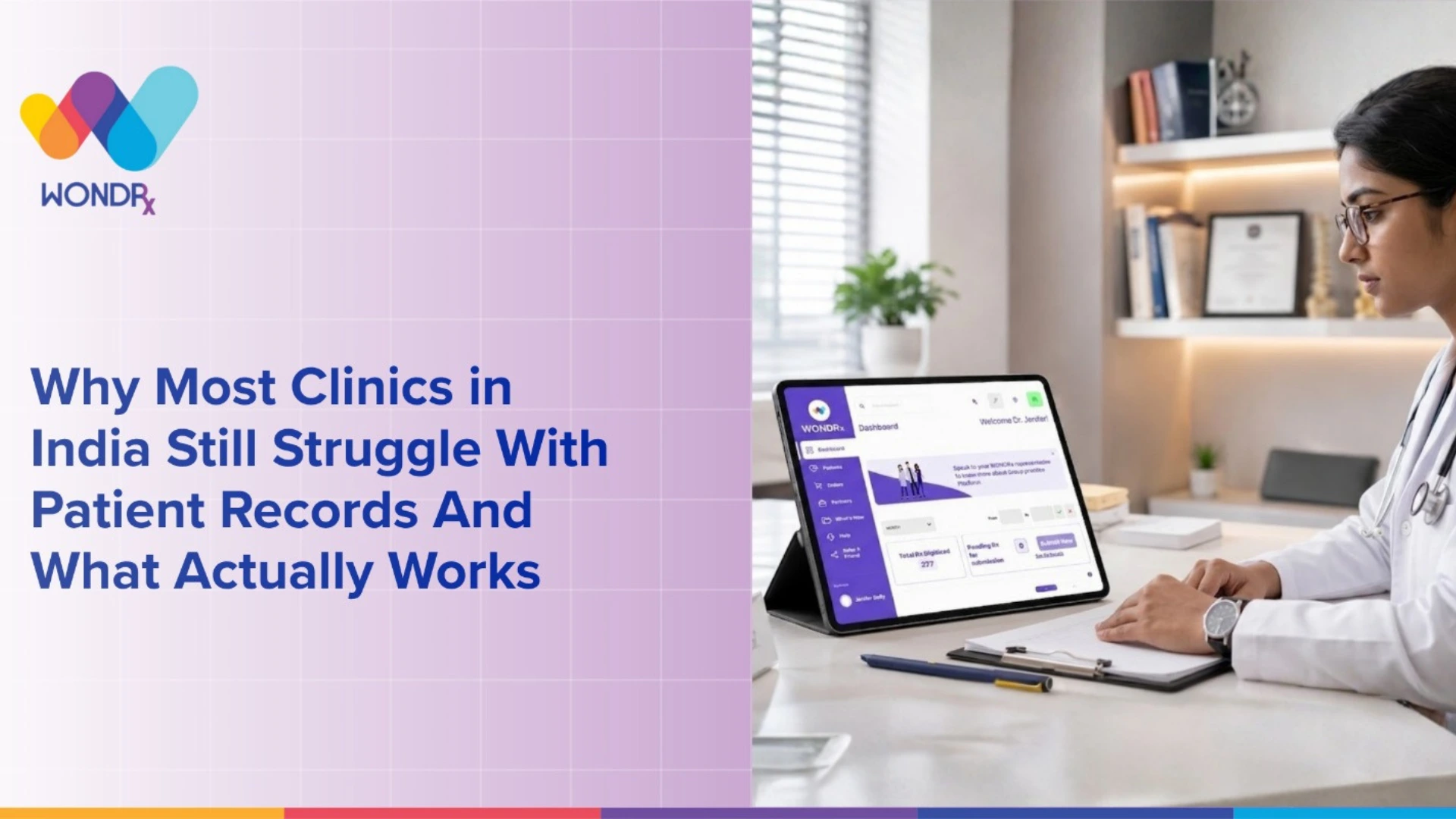
WONDRx is built around this exact problem. platform digitizes handwritten prescriptions as part of natural clinic workflow no typing required from doctor. The prescription is written on paper. Conversion to structured, searchable digital data happens automatically.
For an OPD doctor, nothing changes. For the data layer above the clinic, everything changes.
This means prescription data from private OPDs including clinics in tier 2 and tier 3 cities that current pharma commercial analytics platforms have never been able to reach becomes part of a structured, analyzable dataset.
The result is commercial intelligence from the point of prescribing, not from downstream dispensing. It is a data source that India’s pharma analytics infrastructure has needed and not had.
Why This Matters Now
India’s pharma commercial analytics space is investing heavily in AI models, predictive forecasting, and omnichannel engagement measurement. Challenge in commercial analytics for pharma is rarely a shortage of data; it is a surplus of disconnected data arriving through incompatible systems, on incompatible timelines, with no unified layer to reconcile it.
That is true globally. In India, the problem is more fundamental. Before worrying about reconciling data across systems, you need to capture primary prescribing events. You need OPD data that currently does not exist in structured form.
With over 3,000 pharma companies and 10,500 manufacturing units in India, commercial analytics provides a competitive edge by personalizing marketing efforts and predicting future market trends. That competitive edge is built on data. And data built on chemist audits alone has a ceiling.
Pharma companies that move first to incorporate real OPD prescribing data into their commercial analytics will have a structural advantage not in their dashboards, but in signal quality feeding those dashboards.
Conclusion
Pharma commercial analytics in India is not broken. It is operating on incomplete data and the biggest gap is one closest to prescribing decisions.
Most of what Indian doctors prescribe every day is written on paper, in OPD consultation rooms, and disappears from the commercial intelligence picture before it ever reaches a stockist or chemist panel.
Solving this does not require doctors to change how they practice. It requires infrastructure that converts handwritten prescriptions to structured data automatically at clinic, at scale, including in tier 2 and tier 3 markets where the gap is widest.
That is the missing link in pharma commercial analytics for India. And it is now solvable.
If you are building or rethinking your prescription data strategy in India, WONDRx is where that conversation starts. See how OPD level data capture works and what it could mean for your commercial intelligence layer. Book a demo.
FAQs
Why is OPD prescription data not captured in standard pharma analytics platforms in India?
Lorem ipsum dolor sit amet, consectetur adipiscing elit. Ut elit tellus, luctus nec ullamcorper mattis, pulvinar dapibus leo.
How does handwriting to digital conversion help pharma commercial analytics?
When OPD prescriptions are automatically converted from handwritten to structured digital format at clinic level, prescribing data becomes available in a form that can be analyzed. This means molecule choice, brand selection, co-prescription patterns, and diagnostic context can capture data that chemist audits cannot provide. This is what makes pharma commercial analytics from OPD settings possible.
What makes tier 2 and tier 3 India such a significant gap in prescription data?
Chemist audit panels used by platforms like IQVIA are weighted toward high volume urban pharmacies. Coverage in smaller cities is thin and often extrapolated. Since a large share of India’s private OPD volume is in non metro markets, this creates significant uncertainty in territory level commercial analytics for a majority of countries.
Does collecting OPD prescription data require doctors to change their workflow?
With platforms like WONDRx, no. conversion from handwritten to digital happens automatically. Doctors write prescriptions exactly as they always have. structured data output is generated without any typing, approval step, or workflow modification on the doctor’s part. This zero behavior change approach is what makes OPD data collection scalable across private clinics in India.
How is OPD prescription data different from claims data?
Claims data in markets where it exists (primarily US) captures dispensed prescriptions from pharmacy systems. In India, a claimed infrastructure does not exist at scale for the private outpatient sector. OPD prescription data captured at point of consultation is upstream of dispensing; it reflects what the doctor decided, not what the patient eventually purchased. This makes it more accurate as a representation of prescribing behavior.