TL;DR
- The blog is written for pharma sales leaders, commercial analytics teams, and market intelligence professionals trying to improve coverage and prescription tracking in Indian OPD markets.
- Most pharma commercial analytics tools in India rely on data from hospital chains and large urban clinics leaving millions of private OPD prescriptions completely untracked.
- The real competitive edge in pharma sales is no longer the field force size, it is the quality of prescription-level data from the right geographies.
- Digitizing OPD prescriptions at source creates a structured data layer that can feed directly into commercial analytics pipelines without disrupting how doctors currently work.
- Pharma companies that invest in better prescription data infrastructure now will have a measurable advantage in territory planning, brand performance tracking, and field force ROI.
Pharma companies spend crores every year on sales analytics platforms. They track market share, monitor competitor brands, map field force coverage, and run complex models to forecast demand.
But there is a fundamental problem sitting at the base of all that analysis.
The prescription data feeding those models is incomplete. And in India, it is significantly incomplete.
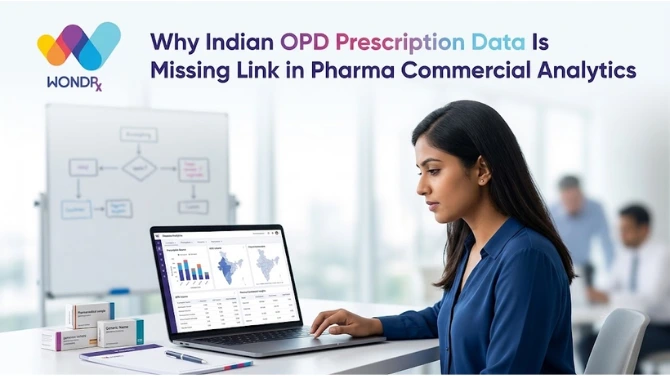
Pharma sales teams are often flying blind in tier 2 and tier 3 markets because prescription data from these regions barely exists in structured form. While metro cities generate relatively better visibility through hospital networks and organised healthcare systems, a large share of outpatient prescribing behavior across smaller cities and towns remains untracked.
This creates a major gap in pharmaceutical commercial analytics. Without reliable OPD prescription data, companies struggle to understand real prescribing patterns, evaluate brand penetration accurately, optimize territory planning, and deploy field forces effectively.
This blog explains why OPD prescription data is the missing layer in pharmaceutical commercial analytics and what this visibility gap means for sales strategy, market expansion, and decision-making across India’s healthcare landscape.
Also Read,
- Why Digital Prescriptions Are Replacing Paper Records
- 5 Ways Technology Helps Patients Stay Healthier
- From Handwritten to Digital: What the Prescription Transition Really Looks Like in an Indian Clinic
The Prescription Data Gap Nobody Talks About
The pharmaceutical commercial analytics space in India is dominated by a handful of data providers. Most of them aggregate prescription data from stockists, distributors, retail chemists, and select hospital networks. The coverage looks solid on paper.
In practice, a large portion of actual prescriptions written every day never enter any structured data system at all.
These are the prescriptions written by private OPD doctors in tier 2 cities, small towns, and semi-urban clinics. Doctors who see 60, 80, sometimes over 100 patients in a single day. Doctors who write on paper because no existing software fits the speed at which they work.
This is not a small segment. Private OPD doctors account for the majority of primary care prescriptions in India. What happens in these clinics directly shapes brand performance for generics, branded formulations, and specialist drugs across therapeutic areas.
Yet for most pharmaceutical commercial analytics systems, this segment is essentially a black box.
Why Existing Data Sources Fall Short
The primary data sources available to pharma commercial teams today each have structural limitations.
Stockist and distributor data shows movement of product but not the prescriber. You can see that a stockist in Nashik moved 500 units of a particular molecule in a month. You cannot see which doctors prescribed it, in what patient contexts, or how that compares to competing brands being written in the same territory.
Retail audit data captures pharmacy-level dispensing. This is more useful but still two steps removed from the prescription itself. By the time a prescription reaches a chemist and gets captured in a retail audit, a significant amount of prescriber-level intelligence has been lost.
Panel-based prescription tracking, where a sample of doctors report their prescribing habits, introduces selection bias. The doctors willing to participate in panels tend to be more digitally active, more urban, and more accessible to medical representatives. The high-volume OPD doctor in a small town is systematically underrepresented.
The result is that pharmaceutical commercial analytics in India has historically been most reliable in metros and large cities, weakest exactly where a large portion of prescription volume actually originates.
What Prescription-Level Data Actually Enables
When pharma commercial teams have clean, structured, prescription-level data from OPD doctors, the quality of decisions that become possible changes substantially.
Territory planning becomes evidence-based. Instead of deploying field force based on city tier or historical representative relationships, teams can allocate resources based on where actual prescription volume is concentrated. A cluster of high-volume OPD doctors in a tier 3 district may represent more opportunity than an entire metro territory with lower script volumes per doctor.
Brand performance tracking moves from aggregate to granular. Knowing that a brand has 18% market share nationally is less useful than knowing that in a specific district, a key molecule is being under-prescribed relative to its competition across a specific doctor profile. Prescription-level data makes these distinctions visible.
Field force ROI calculation improves. When you can link MR visits to prescription behavior change, you can measure whether a representative interaction actually moved the needle. Without prescription data from the relevant doctor, that causal link is inferred at best.
Early signals on competitor activity become detectable. Prescription data from real OPD visits can show brand switching, new product uptake, and therapy area shifts months before those trends show up in aggregated distributor or retail data.
The Digitization Layer That Makes This Possible
The prescription data gap in Indian OPD markets is not a demand problem. Pharma companies want this data. The gap exists because the supply side of the actual creation of structured prescription records at source has never scaled in private OPD clinics.
Most EMR and e-prescription tools require doctors to type. In a high-volume OPD where a consultation lasts three to five minutes, that requirement kills adoption. Doctors who tried these systems reverted to paper within days. The structured data that would feed pharmaceutical commercial analytics systems never got created.
This is the problem that WONDRx solves at the source.
WONDRx converts handwritten prescriptions into digital records without requiring doctors to change how they work. The doctor writes on paper as they always have. The prescription gets digitized in real time. No typing. No workflow change. No training curve.
The result is that OPD prescription data from private clinics including clinics in tier 2 and tier 3 markets gets captured in structured, searchable form for the first time.
For pharmaceutical commercial analytics, this creates a data layer that has not previously existed at this scale: prescription-level records from the segment of doctors whose prescribing behavior most influences primary care outcomes across India.
What This Means for Pharma Commercial Teams
The implications for how pharma sales and marketing organizations use data are significant.
Brands that have historically struggled to measure performance in non-metro markets now have a path to real prescription-level visibility in those geographies. The high-volume private OPD doctor who was essentially invisible in existing data systems becomes a trackable, measurable part of the commercial analytics picture.
Field force deployment decisions that were based on proxy indicators, city population, chemist density, and historical call rates can shift toward decisions based on actual prescribing volume and brand penetration at the doctor level.
KOL identification and engagement programs can expand beyond hospital-based specialists to include high-influence OPD doctors in smaller cities whose prescription volumes rival or exceed their urban counterparts.
Market intelligence on new molecule uptake, therapy area trends, and competitor brand activity becomes available from geographies where it was previously unavailable or severely delayed.
The Competitive Intelligence Angle
As prescription data from OPD clinics becomes more structured and accessible, the pharma companies that build pipelines to this data first will have a structural advantage over those that do not. Territory planning based on real prescription volumes will consistently outperform planning based on proxy data. Sales force allocation guided by actual brand performance at the doctor level will yield better ROI than allocation guided by distributor movement.
The companies still relying on incomplete data will not necessarily know their analysis is missing a significant segment. Their models will look complete because they will be calibrated on the data that exists, not the data that is absent.
That is the nature of a data gap. It is invisible from inside the gap.
Conclusion
Pharmaceutical commercial analytics in India has matured significantly over the last decade. Platforms are more sophisticated. Models are more complex. Field force tools have improved substantially.
But the underlying data quality problem in private OPD markets remains unsolved. And data quality is ultimately the ceiling on how good any analytics output can be.
The prescription written by a doctor in Raipur or Coimbatore or Surat is just as commercially relevant as one written in Mumbai. It has simply been harder to capture in structured form.
As OPD digitization scales through tools that actually work in high-volume clinic environments, that data gap starts to close. For pharma commercial analytics teams, that shift represents one of the more consequential changes in Indian market intelligence in recent years.
If you want to understand how WONDRx prescription data can integrate with your pharma commercial analytics pipeline, get in touch with our team.
FAQs
Q: What makes OPD prescription data different from hospital or pharmacy data for commercial analytics?
OPD prescription data captures the decision at the point it is made, by the individual prescribing doctor, before the prescription reaches a chemist or distributor. This prescriber-level resolution is what enables meaningful brand performance tracking and field force ROI measurement. Hospital and pharmacy data typically aggregates across multiple prescribers and loses this granularity.
Q: How does WONDRx capture prescription data without disrupting how doctors work?
WONDRx converts handwritten prescriptions to digital records in real time. Doctors continue writing on paper as they always have. There is no typing requirement and no change to the consultation workflow. This is what makes OPD adoption realistic in high-volume clinic settings where previous digitization attempts failed.
Q: How reliable is prescription data from private OPD clinics compared to panel-based data?
Panel-based prescription data relies on a sample of doctors who agree to report their prescribing activity. This introduces selection bias toward urban, digitally active physicians. OPD prescription data captured at source from actual consultations is not sample-based and is not subject to the same reporting biases. For tier 2 and tier 3 markets specifically, source-captured data is substantially more representative.
Q: Can WONDRx prescription data be used alongside existing commercial analytics platforms?
Yes. Structured prescription data from WONDRx can be integrated into existing pharmaceutical commercial analytics workflows as a data layer. The value is additive; it fills a geographic and prescriber-segment gap that existing data sources do not adequately cover.
Q: What therapeutic areas benefit most from better OPD prescription data coverage?
Therapeutic areas with significant primary care prescription volume benefit most: general medicine, diabetology, cardiology, respiratory, gastroenterology, and dermatology. These are areas where private OPD doctors drive a substantial share of prescriptions and where the gap between actual market behavior and what traditional data sources capture is most pronounced.