
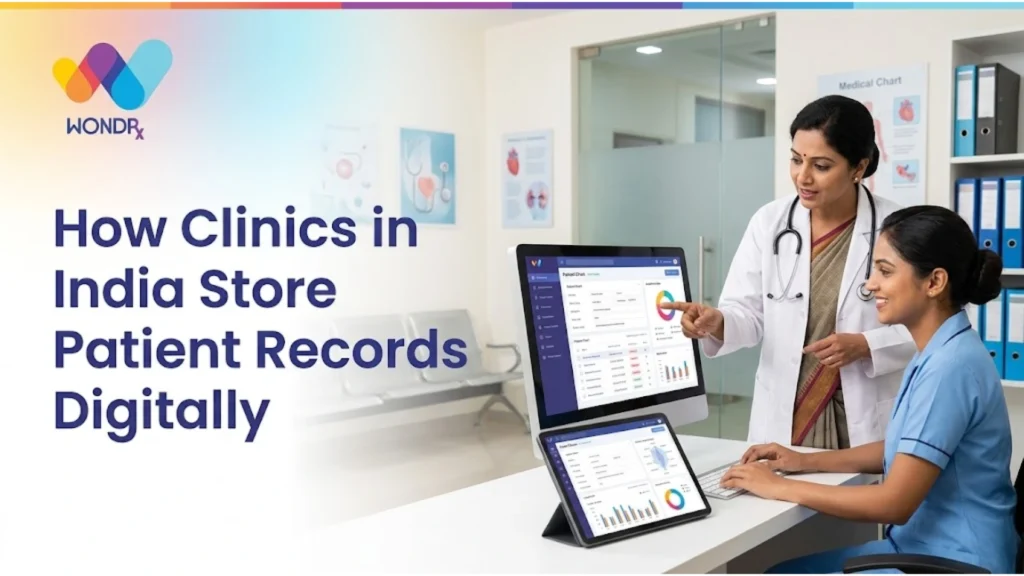
TL;DR
- This blog is written for Indian doctors, clinic owners, and healthcare practitioners looking to digitize patient records without disrupting their existing OPD workflow.
- Most Indian clinics still rely on paper-based systems or partial digital setups, leading to issues like lost records, fragmented patient history, and inefficiencies in follow-ups.
- The biggest challenge is not cost or awareness but the time and effort required for typing, especially in high-volume OPDs.
- Digital patient records improve accessibility, reduce errors, enable better clinical decisions, and align with initiatives like the Ayushman Bharat Digital Mission (ABDM).
- Modern EMR solutions that reduce or eliminate typing along with secure storage, standardized data entry, and regular backups can help clinics transition smoothly without changing their workflow.
The healthcare sector in India is gradually digitizing, with clinics shifting from paper based records to more efficient digital solutions. Handwritten prescriptions and physical files have long led to errors, misplaced information, and gaps in patient care. With patient volumes rising, the need for organized and accessible records has never been more urgent.
Estimates suggest that a minority of Indian hospitals have implemented EMR systems, with adoption concentrated in large private hospitals in urban areas. and most of those are large private hospitals in urban areas. The smaller clinics serving the bulk of India’s outpatient population are still running on paper. Clinics are turning to electronic medical records software in India to close this gap, keeping patient information secure and accessible without adding to doctor’s workload.
How Indian Clinics Really Store Patient Records Today
The reality of patient record management in a typical Indian OPD is not what software vendors imagine it to be.
Most clinics operate one of three ways. First is full paper handwritten prescriptions, physical case files, registers at reception. The second is a hybrid system where the reception desk uses basic software for billing or appointments, but the doctor still writes prescriptions by hand. Third, increasingly common in urban clinics, is some form of digital entry but it is usually receptionist or a junior staff member typing notes after the fact, not doctor during consultation.
In all three models, handwritten prescriptions remain the default. It is fast. It requires no training. It does not need Wi-Fi. And for a doctor seeing 60 to 80 patients in a morning OPD, it simply works.
The problem is what happens after. Paper prescriptions get lost. Physical files are hard to search. When a patient returns after six months, finding their previous prescription depends on whether they brought their own copy. Follow ups become guesswork. Drug interaction checks are manual. And if a patient visits a different clinic or a specialist, their history goes with them on a crumpled piece of paper or does not go at all.
This is the real cost of paper based record keeping in Indian clinics. Not inefficiency in some abstract sense, but actual gaps in patient care that happen every single day. But the bigger question is why have clinics not switched to digital despite knowing these problems exist?
Adoption Problem Is Not Awareness. It Is Typing.
Ask any Indian doctor who has tried and abandoned an EMR why they stopped using it. The answer is almost always the same: it took too long to enter data.
This is the core barrier to digital record keeping in Indian clinics. Not cost. Not awareness. Not lack of technical literacy. Typing.
Doctors in India, especially those in private practice with high patient volumes are not slow adopters of technology. Most of them use WhatsApp to share reports, YouTube to stay updated on medical developments, and smartphones for everything else in their lives. They are not afraid of digital tools. They are afraid of digital tools that slow them down.
The solution, then, is not to build faster typing interfaces or better keyboard shortcuts. It is to significantly reduce or streamline the typing requirement.
Why Digital Record Keeping Is Essential for Clinics in India
A doctor who sees 70 patients a day cannot afford to spend two minutes per patient searching for last visit’s prescription. That is the real reason digital records matter not compliance, not trends, but daily clinical cost of fragmented information.
Initiatives like the Ayushman Bharat Digital Mission (ABDM) are also pushing clinics toward standardized digital systems. ABDM linked records allow patient data to be accessed and shared across providers, which reduces repeat testing, improves referral quality, and gives doctors a more complete picture of a patient’s history. For clinics looking to adopt electronic medical records software in India, ABDM compliance is worth factoring in from the start.
What Is Electronic Medical Records Software?
EMR software is a digital system that clinics use to store, manage, and retrieve patient health data in one place. It replaces paper records with searchable, structured information making it easier for doctors to track patient history and prescribe consistently. Electronic medical records software in India is helping clinics across specialties move away from fragmented paper files toward organized, accessible records.
EMR and EHR (Electronic Health Records) are often used interchangeably, but there is a practical difference. EMR is typically used within a single clinic or practice. EHR is designed to share data across multiple healthcare providers. Most clinics start with EMR systems covering patient history, e-prescriptions, lab report integration, and appointment management.
Best Practices for Digital Patient Record Management
Adopting electronic medical records software in India is only the first step. The way a clinic implements and manages it determines whether it actually holds up in daily practice.
Ensure Data Security and Privacy Patient data must be protected with encryption, secure login procedures, and role based access controls. Clinics should also follow Indian healthcare data regulations to ensure sensitive information is handled legally and ethically.
Choose ABDM Compliant Software Software that is compatible with Ayushman Bharat Digital Mission supports ABHA ID integration and enables secure sharing of patient data across providers. This is particularly relevant as India’s digital health infrastructure continues to expand.
Standardize Data Entry Consistent data entry prevents confusion and errors over time. Structured templates and predefined formats make patient records easier to read, search, and act on especially when a patient returns after a long gap.
Back Up Data Regularly Automated backup systems protect patient records against technical failures or security incidents. A clinic’s digital records are only as reliable as infrastructure keeping them safe.
How WONDRx Handles Digital Records Without Changing Your OPD Workflow
WONDRx is built specifically for how Indian OPDs actually operate fast, high volume, and handwriting dependent.
The core idea is straightforward. Instead of requiring doctors to type prescriptions into a software system, WONDRx digitizes handwritten prescriptions as they are written. The doctor writes on a smart prescription pad exactly as they always have. WONDRx captures that data and converts it into a structured digital record with medicines, dosages, diagnoses, and patient details all organized and searchable.
There is minimal typing required and little to no change in how the doctor runs their OPD.What the clinic gets on the other side is a full digital patient history that builds itself over time. Every visit is captured. Previous prescriptions are searchable in seconds. Drug interactions can be flagged automatically. And when a patient returns even after months, the doctor can see exactly what was prescribed last time without asking the patient to remember.
For clinic staff, it means the reception desk is not manually re-entering data from paper slips. For the doctor, it means a digital record exists without requiring any extra time or effort during consultation. For the patient, it means continuity of care that was simply not possible with paper.
This is what working electronic medical records software in India should look like for a high volume OPD zero behavior change, zero typing burden, and digital records that build automatically from workflow that already exists.
Conclusion
Indian clinics that still run on paper are not behind on technology, they are waiting for software that actually fits how they work. That software now exists.
With the right electronic medical records software in India and practices like data security, ABDM compliance, and standardized entry, clinics can build a record system that holds up under real OPD pressure. The shift to digital record keeping is not just about organizing files it is about giving doctors information they need, exactly when they need it, without adding a single extra step to their day.
Want to see how WONDRx converts a handwritten prescription into a digital record in real time?
FAQs
1. What is electronic medical records software in India?
It is a digital platform through which clinics store, manage, and retrieve patient health records replacing paper based systems with organized, searchable data.
2. Is electronic medical records software in India suitable for small clinics?
Yes. Most EMR solutions are built to suit clinics of any size and have scalable functionality that works even in a single doctor practice.
3. How secure is patient data in digital record systems?
Most EMRs use encryption, secure logins, and role based access controls to protect confidential patient data and comply with applicable data laws.
4. What is the difference between EMR and EHR?
EMR is a clinic tool for managing patient records. EHR is designed to share data across multiple healthcare providers and systems.
5. How can clinics transition from paper records to digital systems?
Start by selecting the right EMR software, digitize existing records gradually, standardize data entry formats, and choose a system that works with your existing workflow rather than against it.
Great article! EMR adoption in India requires careful attention to data security, interoperability, usability, and healthcare workflows. I appreciate how this guide highlights practical best practices for implementing electronic medical records effectively. Thanks for sharing these valuable insights!
–
Ciyex – open source EHR
https://ciyex.org/
Thank you for your thoughtful feedback! Glad you found the insights valuable. At WONDRx, we’re focused on making healthcare more connected, secure, and efficient through digital solutions. We appreciate you sharing your perspective!