TL;DR:
- This blog is for Indian doctors, clinic owners, and healthcare professionals managing high-volume OPDs who struggle with patient record management.
- Most clinics still rely on paper files, memory, and scattered tools, leading to lost records, inefficiency, and repeated patient history.
- Traditional electronic health record software is built for hospitals, not fast-paced OPDs, making it slow, complex, and disruptive to existing workflows.
- Poor record management causes clinical risks, wasted staff time, reduced patient trust, and potential medico-legal issues.
- OPD-friendly solutions like WONDRx succeed by adapting to doctors’ existing workflows, digitizing handwritten prescriptions, integrating records, and ensuring fast, simple adoption.
Most Indian doctors already know what the problem is.
Files go missing. Patients retell their history at every visit. Staff spend ten minutes hunting for a record that should take ten seconds to find. And in an OPD seeing 60–80 patients a day, those ten minutes happen over and over again.
This isn’t a technology awareness problem. Most doctors have heard of electronic health record software. Many have even tried it. But adoption in Indian clinics remains stubbornly low and the reason isn’t resistance to change. It’s that most tools were built for hospitals, not for the ground reality of a busy OPD.
Here’s what’s actually happening and what a better approach looks like.
The Real State of Patient Records in Indian Clinics
Walk into most independent clinics in India and you’ll find the same setup: a stack of paper files, a WhatsApp group for lab reports, an Excel sheet someone started two years ago and half-maintains, and a doctor who holds most of the patient history in memory.
This system works until it doesn’t.
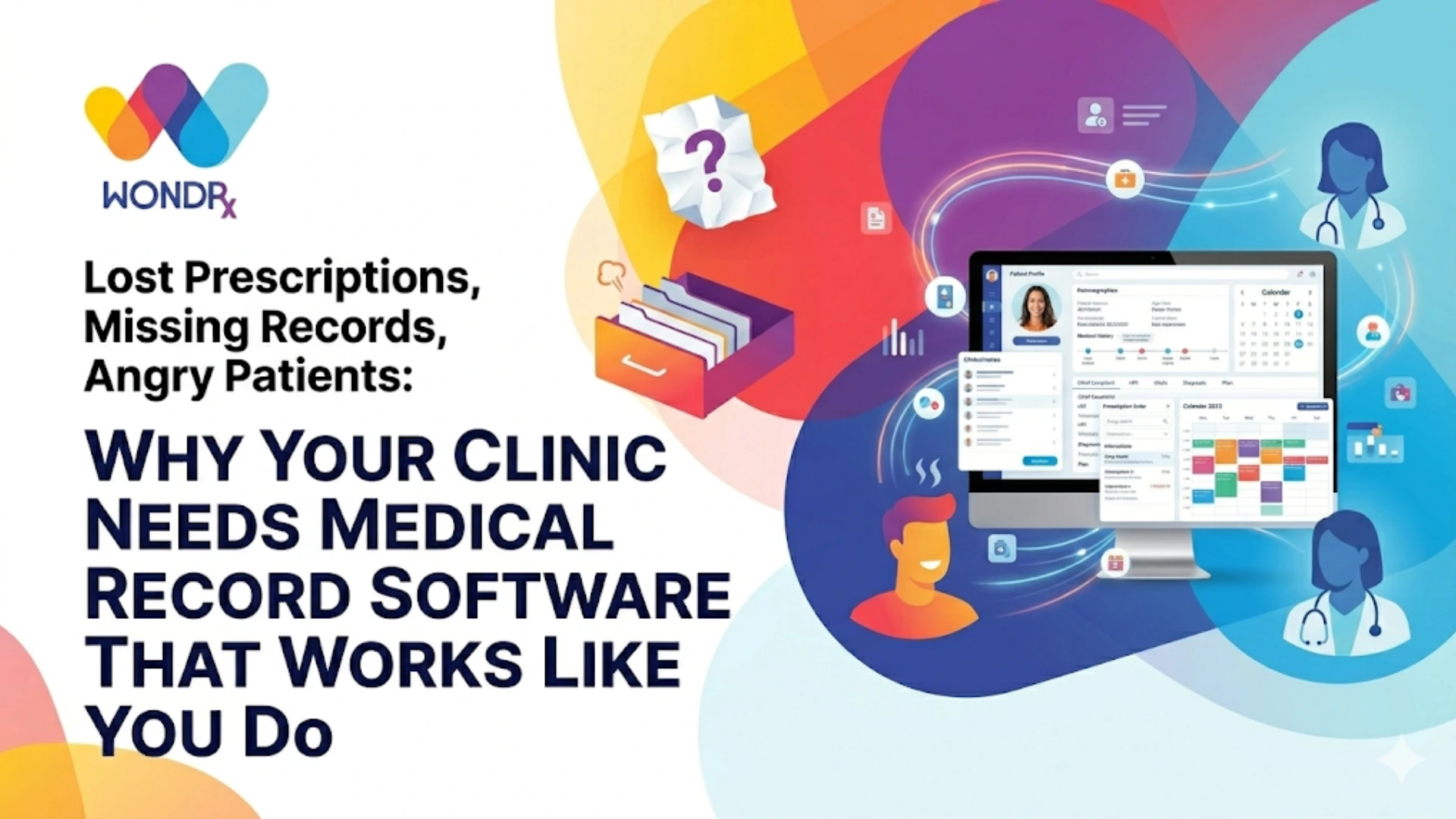
When a patient comes back after six months, their file is buried. When a staff member is absent, nobody knows the filing system. When a prescription needs to be verified, there’s no quick way to pull up history. And in high-volume OPDs, these gaps don’t just create inconvenience; they create clinical risk.
Physicians are forced to rely on what patients remember rather than what was actually documented. That means repeat tests, missed flags, and continuity of care that starts fresh at every visit.
The cost isn’t just efficiency. It’s trust. Patients who have to repeat themselves every single visit quietly start wondering if their doctor actually knows them.
Why Most Clinics Still Haven’t Switched to Electronic Health Record Software?
1. The software wasn’t built for OPD speed
This is the core problem. Most electronic health record software on the market was designed for hospital systems with multi-step data entry, departmental workflows, and IT teams to manage it. When that software lands in a two-doctor clinic, it slows everything down.
Doctors aren’t slow to adopt technology. They’re quick to reject tools that make their day harder. When software demands more clicks than a paper file, they go back to paper. It’s not irrational it’s practical.
2. It requires doctors to change how they work
Most EHR tools ask doctors to stop writing and start typing. In an OPD where a consultation runs 4–6 minutes, switching from handwritten notes to a keyboard is a genuine workflow disruption. Multiply that across 70 patients and you’ve added significant friction to the day.
The tools that fail don’t fail because doctors are old-fashioned. They fail because they demanded behavior change that the workflow couldn’t absorb.
3. Cost misunderstanding blocks even the first conversation
Many clinic owners assume electronic health record software is enterprise-level pricing. That assumption alone prevents smaller clinics from exploring modern, affordable solutions built specifically for independent practices.
The irony: the cost of not having a structured system lost records, repeat diagnostics, staff time spent on retrieval often far exceeds any software subscription.
4. Poor onboarding kills adoption before it starts
Even when clinics do invest in software, many get handed a login and a manual. No guided setup, no workflow-specific training, no check-in after week one. Staff get frustrated, doctors get impatient, and the tool gets abandoned.
Software that doesn’t come with real support isn’t a solution it’s a liability.
5. Infrastructure gaps in tier-2 and tier-3 cities
Reliable internet isn’t a given everywhere. Cloud-dependent tools that freeze mid-consultation or require stable connectivity become liabilities in cities where bandwidth is inconsistent. Until a solution works reliably in these conditions, paper will always feel safer.
What It Actually Costs When Records Go Missing
Let’s be specific. Missing or incomplete records create:
- Clinical risk Doctors make decisions without full history. Misdiagnoses happen. Redundant tests get ordered.
- Staff time drain Locating a file, reconstructing a record, or re-entering patient data wastes 5–15 minutes per gap. In a busy OPD, that’s significant.
- Patient trust erosion A patient who repeats their history for the fourth time at the same clinic doesn’t feel cared for. They start looking for a doctor who remembers them.
- Medico-legal exposure When treatments need to be defended, handwritten notes and fragmented records are difficult to present coherently. Documented, time-stamped digital records are a different story entirely.
What Actually Works: The Right Approach for Indian Clinics
Software That Adapts to Doctors Not the Other Way Around
The most important shift is this: the right electronic health record software shouldn’t ask doctors to change how they work. It should fit into how they already work.
That means for most Indian doctors it needs to work with handwritten prescriptions, not replace them. It needs to be fast, require minimal steps, and be usable even by staff with limited tech exposure.
This is exactly where WONDRx is built differently.
WONDRx converts handwritten prescriptions into structured digital records automatically. Doctors write the way they always have on paper and the prescription gets digitized without any typing, any new interface to learn, or any change to the consultation flow. In a 70-patient OPD, that’s not a small thing. That’s the difference between adoption and abandonment.
No typing. No new behavior. Just your handwriting now digital.
Integrated Records, Not Fragmented Tools
Switching between a billing app, a lab portal, and a prescription tool creates its own chaos. The right system brings consultation notes, prescriptions, lab reports, and billing into one connected view.
When a patient walks in for a follow-up, everything from their last visit is already there no searching, no reconstructing, no asking them to repeat themselves.
Cloud Access That Works for Indian Clinics
Patient data should be accessible when needed whether that’s during a home visit, a late-evening follow-up call, or pulling records between clinic locations. Cloud-based access makes that possible without the risk of physical file loss.
The right system also needs to handle low-connectivity situations gracefully, not break under them.
Localized for How Indian OPDs Actually Run
Regional language support, prescription formats that match Indian standards, workflows that account for high patient volume these aren’t nice-to-haves. For a clinic in Lucknow, Coimbatore, or Nagpur, they’re the baseline for usability.
Onboarding That Actually Sticks
Real adoption requires more than handing over a tool. It needs guided setup, staff walkthroughs, and ongoing support that’s available when something goes wrong not just in week one.
A Practical Transition Plan for Clinics Ready to Make the Move
Step 1: Identify where your current system breaks down Where do files go missing? Where does staff spend time on retrieval? Where does patient continuity actually fail? These gaps tell you what to solve first.
Step 2: Choose software built for your OPD reality Not hospital software. Not generic productivity tools. Look for electronic health record software designed for the speed, volume, and workflow of an independent Indian clinic. Ask specifically: does it require behavior change from the doctor?
Step 3: Start with new patients Don’t attempt a full historical data migration on day one. Begin with new patients and new consultations. Let the system prove itself in real conditions.
Step 4: Train staff not just doctors The staff member who manages files, handles billing, and routes patients is often the adoption bottleneck. Train them properly, and doctor adoption follows naturally.
Step 5: Digitize historical records gradually Move old records into the system incrementally by patient visit frequency or clinical priority. There’s no need to pause operations for a big-bang migration.
Indian clinics aren’t struggling with patient records because doctors don’t care about technology. They’re struggling because most available tools were designed for a different kind of practice and the gap between hospital-grade software and real OPD reality has never been properly addressed.
The clinics that are getting this right share one thing in common: they found a system that fit their workflow, not one that rewrote it.
If you’re seeing 50+ patients a day and still managing records on paper or across disconnected tools, the question isn’t whether to change , it’s which change will actually stick.
Want to see how WONDRx works in a real OPD setup? Book a 15-minute demo,
No setup. No commitment. Just a live look at how your handwriting becomes a structured digital record.